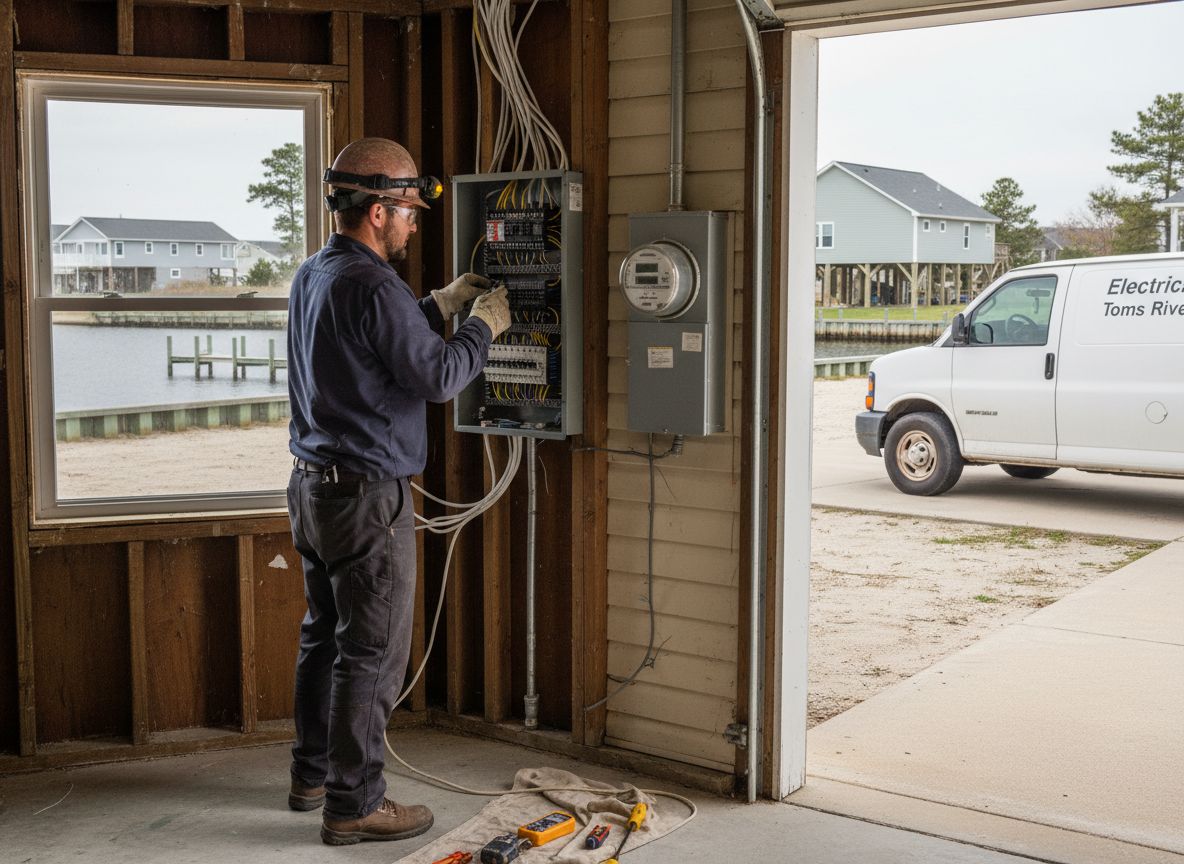
Residential electrical work covers everything downstream of the meter: the service panel, the branch circuits, the receptacles, switches, fixtures and hardwired appliances in a house. Electrician Toms River NJ is a licensed and insured, owner operated electrical contractor working in Toms River, New Jersey. Diagnosis starts at the panel, not at the symptom. A dead outlet gets traced back through the circuit: breaker condition, neutral bar landing, junction boxes on the same run, and the backstab connections behind the receptacles, which fail more often than the wire itself. Voltage readings under load tell you more than readings on an idle circuit, so we load the circuit before drawing conclusions.
Housing stock in Toms River sorts into a few predictable groups, and each one fails in its own way. Holiday City and Silver Ridge Park are slab on grade ranches from the 1960s through the 1980s, mostly 100 amp services with aluminum branch wiring and original receptacles that have gone loose at the terminations. Older streets near downtown and the river hold early 1900s houses with cloth wiring, fuse panels and ungrounded two prong outlets. Bayfront and lagoon homes deal with salt air, so outdoor receptacles, disconnects and dock circuits corrode years before their inland equivalents. Summer rental occupancy pushes AC load onto services that were never sized for it.
Most residential work in Toms River requires an electrical permit from the Toms River Township Building Department, and inspection under the New Jersey Uniform Construction Code, whose electrical subcode is based on the NEC. New circuits, panel work, service changes, and anything opened inside a wall generally get a rough inspection while the boxes and cable runs are still visible, then a final once devices and covers are on. Like for like device swaps are usually exempt, but adding circuits, a subpanel or a feeder is not. In flood zones the inspector will also look at how high service equipment sits relative to base flood elevation.
The jobs that go sideways are usually the ones where the previous work was undocumented. Aluminum branch wiring is the big one: it is legal in place, but it needs proper terminations such as AlumiConn or COPALUM connectors, and swapping in a device not rated CO/ALR makes the connection worse, not better. Shared neutrals from a multiwire branch circuit will bite anyone who assumes one breaker kills a box. Backfed generator connections wired without an interlock kit are still turning up. And on raised houses, feeders that were run during the Sandy rebuild sometimes lack proper support or a corrosion resistant enclosure where they pass through the exterior.
Technician insight
What catches people out on residential work in Toms River is what sits behind the device, not the device itself. In the Holiday City and Silver Ridge Park ranches I open up, aluminum branch wiring is legal to leave in place, but the terminations loosen over the years, and dropping in an ordinary copper only receptacle makes that connection worse instead of better. The other one is a multiwire branch circuit with a shared neutral, where shutting one breaker off does not make the box safe to work in. I also put the circuit under load before I judge it, because a reading on an idle circuit tells me almost nothing.
Intermittent Kitchen Receptacles in Gilford Park
A slab on grade ranch in Gilford Park from the mid 1960s had a run of kitchen and dining receptacles that went dead intermittently, usually when the microwave and the toaster ran at the same time. Testing under load showed voltage at the first box but a bad drop further along the run. Opening the boxes found aluminum branch wiring landed on backstab connections in standard copper only receptacles, with one termination already discolored. We replaced the devices with CO/ALR rated hardware, pigtailed the terminations with approved connectors, and retested every box on the circuit under load before closing up.
Residential Electrician Services We Offer
✓Outlet and Switch Repair or Replacement
Dead, loose or scorched receptacles get replaced with properly terminated devices, including CO/ALR rated hardware or pigtailed connectors where aluminum branch wiring is present.
✓GFCI and AFCI Protection
Kitchen, bath, laundry, garage, basement, exterior and pool area receptacles brought up to current GFCI requirements, plus arc fault protection where the code and the panel allow it.
✓Recessed and Interior Lighting
Layout, cutting, wiring and dimmer selection for LED recessed lighting, under cabinet lighting and fixture replacement, including retrofits into plaster and lath ceilings.
✓Ceiling Fan Installation
Fan rated box installation and support, existing box replacement, and running new switched circuits for rooms that only have a single switch leg.
✓Dedicated Appliance Circuits
New 20 amp, 30 amp or 50 amp circuits for ranges, dryers, wall ovens, microwaves, freezers, well pumps and window or mini split AC equipment.
✓Whole Home Surge Protection
Panel mounted surge protective devices installed at the service, which matter here because coastal storm activity and repeat utility switching send transients through the house.
✓Standby Generator and Interlock Wiring
Transfer switch or panel interlock kit installation, generator inlet boxes and circuit selection so critical loads run legally and safely during an outage.
✓Pool, Spa and Dock Circuits
Equipment circuits, GFCI protection, equipotential bonding grids around pools and hot tubs, plus boat lift, dock lighting and shore power wiring on lagoon property.
How it works
- 1
Walkthrough and Panel Review
We start at the service panel: amperage, breaker condition, bus and neutral bar terminations, double taps and available spaces, then walk the circuits involved in the request.
- 2
Live Testing and Scope
Circuits are tested under load, not just for presence of voltage, so intermittent faults, shared neutrals and open grounds show themselves before anything is quoted.
- 3
Permit, Materials and Schedule
Where the work is permit bearing, the application goes to the Toms River Township Building Department before we start, and material is staged so the house is not left opened up waiting.
- 4
Install, Inspect, Close Up
Rough inspection while boxes and cable are exposed, then devices, covers and labeling, then final inspection and a walkthrough of what changed at the panel.
Pricing
Residential pricing moves on access, circuit length and what we find inside the walls. A device swap in an open, grounded box is a short visit. The same swap in a 1960s slab ranch with aluminum branch wiring, no attic above the room and a panel with no spare spaces turns into a longer job with different material. Fishing a new circuit through a finished basement ceiling is straightforward; fishing the same circuit through plaster, blocking and a raised crawlspace is not. Permit fees, inspection trips, drywall or plaster repair, and whether the panel has capacity all shift the number. Simple service calls often land in the low hundreds, while multi circuit work runs into the low thousands, and the honest answer is that we price after seeing the panel and the route, not before.