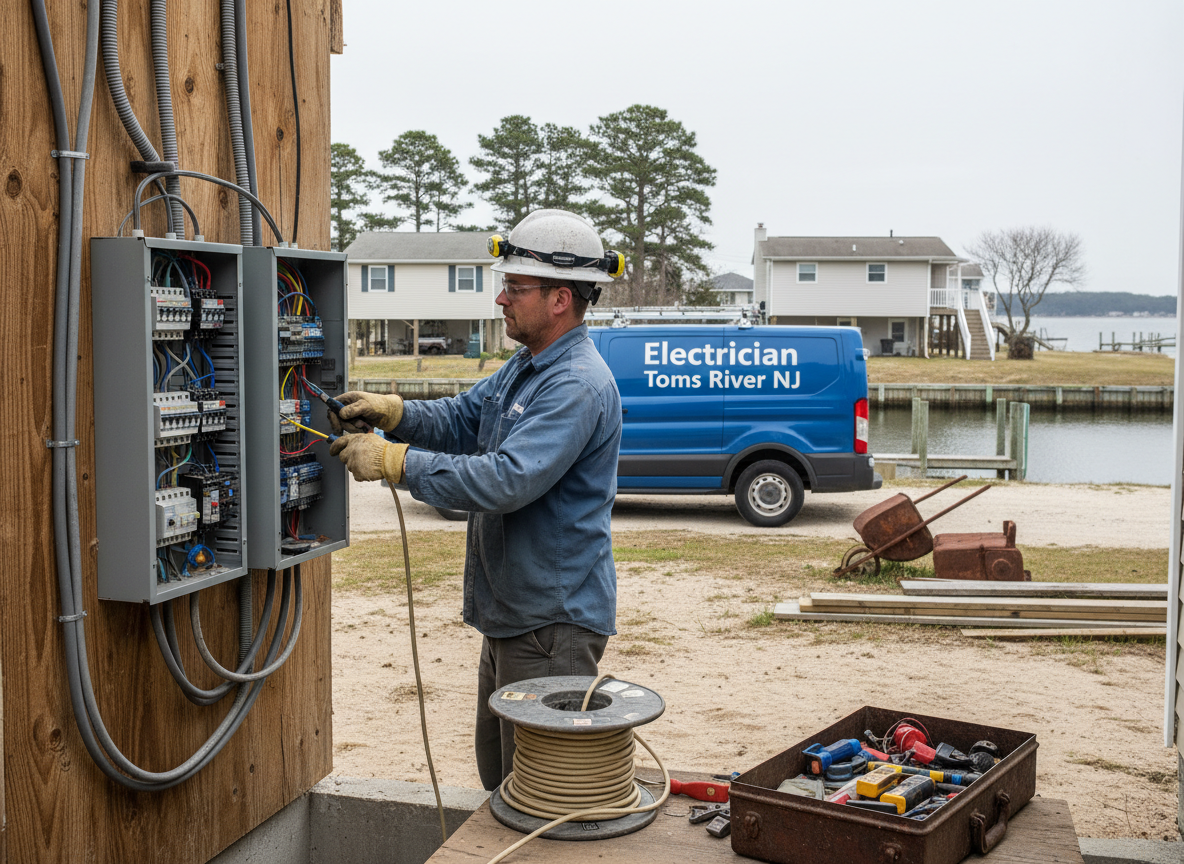
Rewiring replaces the branch circuit wiring in a house: the cable running through walls, floors and ceilings, the boxes, the devices and the terminations at the panel. Electrician Toms River NJ is a licensed and insured, owner operated electrical contractor in Toms River, New Jersey. It is not a decision made from the panel door. We open a representative sample of boxes and check insulation condition, whether an equipment grounding conductor is present, splice quality, box fill and how many rooms share a circuit. Knob and tube, rubber and cloth insulation that flakes when flexed, ungrounded two prong receptacles and overloaded 15 amp circuits are what push a house from repair into rewire.
Toms River gives you two distinct rewiring populations. The early 1900s housing near downtown and along the river has knob and tube remnants, cloth insulated conductors, fuse panels and no grounding path at all. Then there are the 1960s through 1980s slab on grade ranches in Holiday City and Silver Ridge Park, where the wiring is newer but frequently aluminum branch circuits with original backstabbed receptacles that have loosened over decades. Slab construction removes the easy path, since there is no basement below to fish from, and a low attic with limited access becomes the only route. Summer rental properties add load that older circuits were never designed to carry.
Rewiring is permit bearing without exception. The permit is filed with the Toms River Township Building Department and the work is inspected under the New Jersey Uniform Construction Code, electrical subcode based on the NEC. There is a rough inspection with cable, boxes and staples exposed, then a final after devices, covers and the panel work are complete. Current requirements apply to the new work: AFCI protection on most living space circuits, GFCI in kitchens, baths, laundry, garages, basements and outdoors, tamper resistant receptacles, required receptacle spacing, and dedicated circuits for kitchen small appliances, laundry and bathrooms.
The details that decide how a rewire actually goes are structural. Plaster and lath resists fishing and does not patch like drywall, so access holes have to be planned rather than improvised. Balloon framed older homes give long open stud bays, which helps, while houses with fire blocking or added insulation do not. Removing knob and tube in a partial rewire is where people get caught, since leaving energized legacy conductors buried in insulation defeats the point and inspectors look for it. Aluminum circuits that stay in place need approved terminations. And in raised or flood zone homes, new circuits cannot be run below base flood elevation in ways that put devices and junctions back in harm's way.
Technician insight
Rewiring in Toms River is decided by access, and that is the part homeowners do not see coming. A slab on grade ranch with a low attic and no crawlspace has no easy path for a home run, so the job is really about where I can cut and how few openings I can get away with. Plaster and lath is the other one, because it will not patch like drywall, so I plan and mark the openings in advance instead of chasing the cable and improvising. On a partial rewire, the trap is leaving knob and tube energized under attic insulation, and that is exactly what the inspector goes looking for.
Partial Rewire on a Pleasant Plains Cape
The owners of an early 1900s cape in Pleasant Plains wanted the kitchen and second floor bedrooms rewired after a lamp cord scorched a receptacle. Opening a sample of boxes found cloth insulated conductors that flaked when they were flexed, no equipment grounding conductor anywhere upstairs, two prong receptacles throughout, and a length of knob and tube in the attic still energized and buried under blown insulation. We mapped the circuits, planned the access openings through closets and the attic before cutting any plaster, and ran new grounded home runs with dedicated kitchen small appliance and bathroom circuits. The knob and tube was de energized and the accessible runs removed rather than abandoned in place. The township inspected at rough with the cable and boxes still exposed, and again at final once the devices, covers and panel terminations were done.
House Rewiring Services We Offer
✓Whole House Rewiring
Complete replacement of branch circuit wiring, boxes and devices throughout the home, with a new circuit layout designed for current load rather than the original one.
✓Knob and Tube Removal
Identification, de energizing and removal of accessible knob and tube conductors, including the sections buried under attic insulation that inspectors specifically check.
✓Cloth and Rubber Wiring Replacement
Replacing deteriorated cloth or rubber insulated conductors in older downtown and riverside homes where insulation crumbles at boxes and at the panel.
✓Aluminum Branch Circuit Remediation
Replacing aluminum branch runs, or terminating them with AlumiConn or COPALUM connectors and CO/ALR rated devices where full replacement is not practical.
✓Ungrounded to Grounded Circuit Conversion
Running new grounded circuits to replace two prong outlets, so equipment grounding and surge protection actually work as intended.
✓Partial or Room by Room Rewiring
Rewiring kitchens, baths, additions or a single floor in stages, sequenced so the finished portions pass inspection and the house stays livable.
✓Kitchen and Bath Circuit Upgrades
Dedicated small appliance, dishwasher, disposal, microwave and bathroom circuits with the GFCI and AFCI protection those spaces require.
✓Service Panel Integration
Terminating new home runs on a panel with adequate spaces and breaker types, including panel replacement where the existing load center cannot accept the circuit count.
How it works
- 1
Sample Inspection and Circuit Map
We open a set of representative boxes, test for grounding, check insulation condition, and map what actually shares each circuit before deciding whole house or partial.
- 2
Route Planning and Access
Fishing routes are planned through attic, crawlspace, closets and chases, and the access openings are marked in advance so plaster and finished surfaces are cut deliberately.
- 3
Rough Wiring and Inspection
New home runs, boxes and cable are installed and supported, old conductors are removed or de energized, and the township inspects while everything is still visible.
- 4
Devices, Panel and Final
Receptacles, switches, fixtures and protective devices are installed, circuits are landed and labeled at the panel, and the final inspection closes the permit.
Pricing
Rewiring is priced by access, not by square footage alone. An unfinished basement and a walkable attic in a two story house make most runs reachable, and the job moves. A slab on grade ranch with a low attic, no crawlspace and plaster ceilings means more openings, more time and more patching. Circuit count matters because current requirements add dedicated kitchen, laundry and bathroom circuits that older homes did not have. Knob and tube removal, aluminum remediation, panel replacement to accept the circuit count, and plaster or drywall repair all move the number. So does occupancy, since rewiring around a family living in the house takes longer than an empty one. Whole house rewires typically run into the mid five figures on larger homes and considerably less on a small ranch done in stages, and the honest range only comes after the sample inspection.