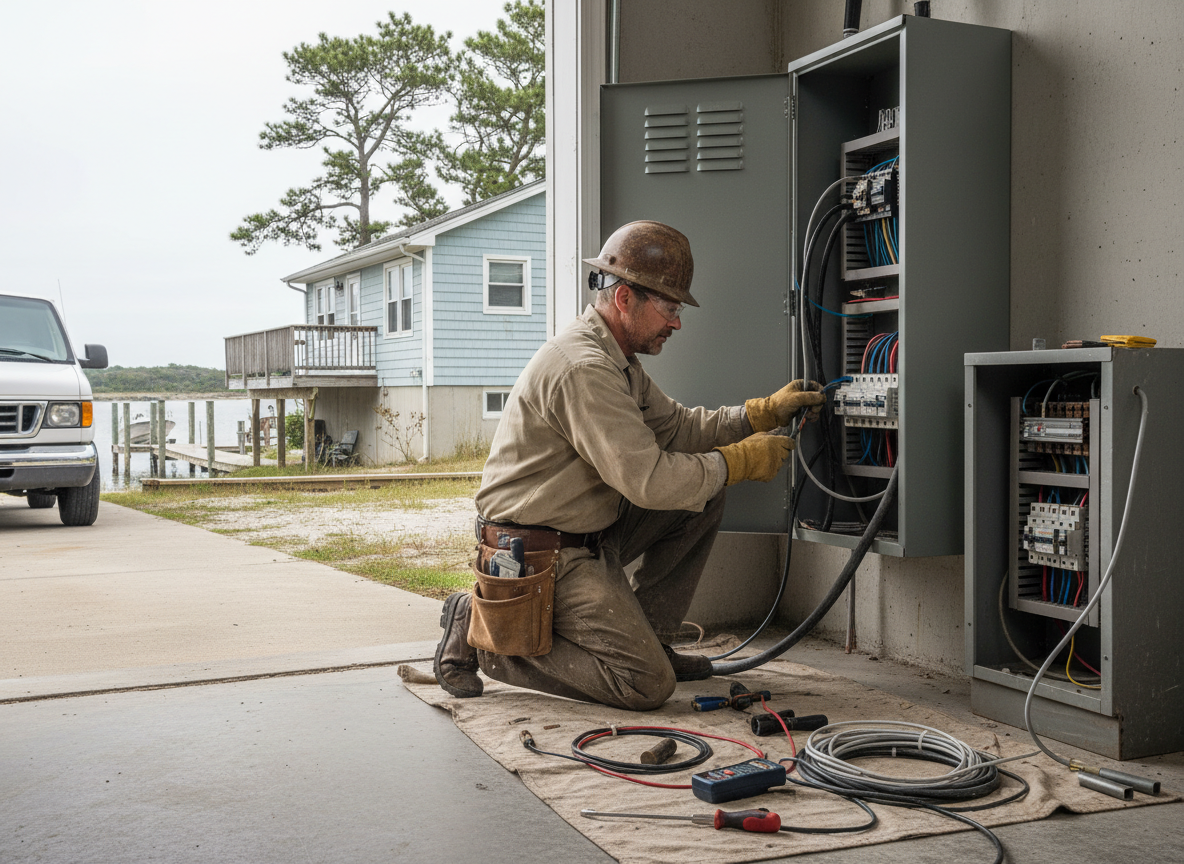
A panel upgrade increases how much power the house can draw. That means a larger load center, larger service entrance conductors, a new meter base, and usually a new service mast and weatherhead, because raising the rating from 100 amps to 200 amps changes every component between the utility connection and the main breaker. Electrician Toms River NJ is a licensed and insured, owner operated electrical contractor in Toms River, New Jersey. The decision is made with a load calculation under NEC Article 220: square footage, heating and cooling, range, dryer, water heater, well pump, pool equipment and any planned EV charging, added and demand adjusted against the existing service rating.
Demand in Toms River is driven by what people add to older houses. A 1970s Holiday City ranch built for a stove, a dryer and window units now runs central air, a heat pump, a hot tub and sometimes a Level 2 EV charger. Homes raised on pilings after Sandy generally got service equipment relocated above base flood elevation, and many of those services were reconnected at the original 100 amps even though the finished house is larger. Additions, finished basements above the flood line, garage conversions and detached garages all push the calculation past what the existing service can legally carry.
Every service upgrade in Toms River is permit bearing. The application goes to the Toms River Township Building Department, the work is inspected under the New Jersey Uniform Construction Code with the electrical subcode based on the NEC, and JCP&L has to be scheduled to disconnect and reconnect the service drop or lateral and set the meter. Sequence matters: the township normally releases the service to the utility after the inspection passes, so a missed inspection window means another day without power. In flood zones the inspector will confirm the new meter and panel locations meet elevation requirements before signing.
The parts that surprise people are outside the panel. The grounding electrode system almost always needs work, because a 200 amp service requires a larger grounding electrode conductor and often a second driven rod, and older homes here frequently relied on a water pipe bond that is no longer continuous after a plastic repair. Overhead services need the mast checked for strength and the point of attachment height verified, and a corroded mast on a bayfront house has to be replaced, not reused. Underground laterals may need a new trench if the existing conductors are undersized. Working clearance is the other quiet issue: a larger enclosure in a tight utility room can violate the required space in front of it, which forces a relocation nobody budgeted for.
Technician insight
People call me about a panel upgrade and picture a new box on the wall, but almost everything that decides the job sits outside the panel. On these older Toms River services I am usually replacing the meter base, the service entrance conductors and the mast as well, because they were all sized for 100 amps. The grounding electrode system is the one that catches people every time: a 200 amp service needs a larger grounding electrode conductor and often a second driven rod, and plenty of houses here were relying on a water pipe bond that stopped being continuous the day someone put in a plastic repair. The other surprise is working clearance, since a bigger enclosure in a cramped utility room can force a relocation that was never in anyone's budget.
Service Increase on a Holiday City Ranch
A slab on grade ranch in Holiday City from the early 1970s was tripping its main whenever the central air and the electric dryer ran together, and the owners wanted to add a hot tub. The Article 220 load calculation confirmed the connected and planned load was past what the existing 100 amp service could legally carry. On changeover day JCP&L dropped the service, and we installed a new 200 amp load center, meter base, service entrance conductors and weatherhead, then transferred and labeled every circuit. The grounding electrode conductor was upsized and a supplemental rod driven, since the original water pipe bond had been broken by a plastic repair years earlier. The township inspection passed the same day and the utility reset the meter, so the house was without power for one working day.
Electrical Panel Upgrade Services We Offer
✓100 Amp to 200 Amp Service Increase
The common upgrade for older Toms River homes, including new load center, service entrance conductors, meter base and grounding electrode work.
✓NEC Article 220 Load Calculation
A written calculation of connected and demand load used to size the new service and to document to the inspector why the chosen rating is correct.
✓Meter Base and Service Mast Replacement
New meter enclosure, mast, weatherhead and point of attachment, sized and rated for the higher service and for coastal exposure.
✓Underground Service Lateral Upgrade
Trenching, conduit and larger conductors from the utility point of connection to the meter where the existing lateral cannot carry the new rating.
✓Grounding Electrode System Upgrade
Larger grounding electrode conductor, supplemental ground rods and re bonding of water and gas piping to match the increased service size.
✓Subpanel and Feeder Addition
New feeders and subpanels for additions, detached garages, finished basements or second floors so the upgraded service is actually usable where the load is.
✓Service Relocation Above Base Flood Elevation
Moving meter and panel to an approved height on raised or flood zone property while increasing capacity at the same time.
✓JCP&L Service Coordination
Filing the utility application, scheduling the disconnect and reconnect, and sequencing the township release so the outage stays within one day.
How it works
- 1
Load Calculation and Service Sizing
We inventory the connected load, add what you plan to install, run the Article 220 calculation, and confirm whether 200 amps is the right target or whether the demand justifies more.
- 2
Utility and Township Filing
The permit goes to Toms River Township and the service application goes to JCP&L, since the reconnect date sets the whole schedule.
- 3
Changeover Day
Power comes down, the meter base, service entrance conductors, mast and load center are installed, circuits are transferred and labeled, and the grounding electrode system is upgraded.
- 4
Inspection and Reconnect
The township inspects, the release goes to JCP&L, the meter is set, and we verify voltage, phase, breaker function and grounding before leaving.
Pricing
The panel itself is a minor share of the cost. What moves the price is everything around it: overhead versus underground service, the length and size of the new service entrance conductors, whether the mast and meter base can be replaced in place or must be relocated, and how much grounding electrode work the house needs. Interior conditions matter too, because a panel in a finished basement with a low ceiling and no working clearance costs more than one on an open garage wall. Flood zone elevation requirements, trenching for a lateral, permit fees and utility coordination all add. Most residential 100 amp to 200 amp upgrades in this area fall in the low to mid thousands, and the difference between the bottom and top of that range is almost always relocation, trenching or a mast and meter change, not the load center.