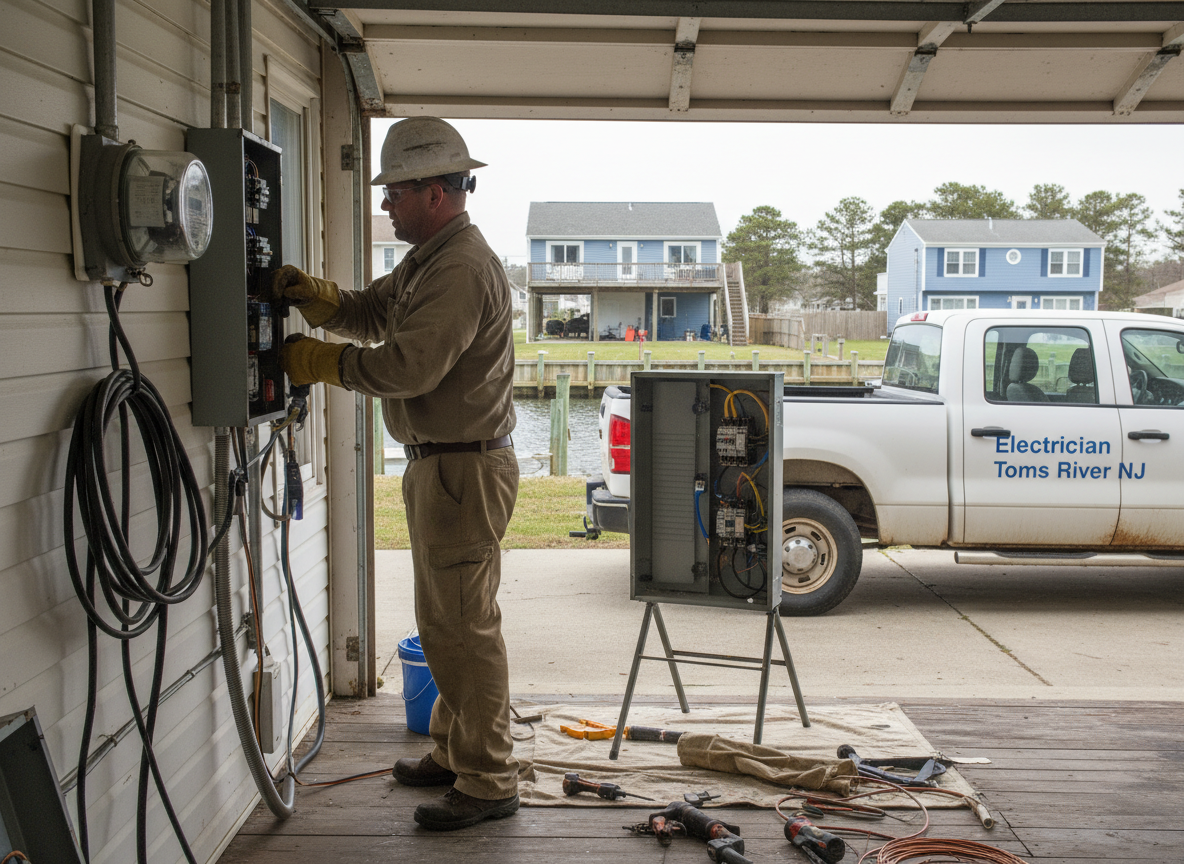
Panel replacement means removing a panel that can no longer be trusted and installing a new load center of the same rating in its place. The service size does not change. What changes is the equipment: the enclosure, the busbar, the main breaker and every branch breaker. Electrician Toms River NJ is a licensed and insured, owner operated electrical contractor in Toms River, New Jersey. Diagnosis is physical. We pull the deadfront and look for discoloration at the bus stabs, melted breaker feet, aluminum oxide on the neutral bar, breakers that no longer clip tight, corrosion tracks below the knockouts, and the smell that a panel gives off after it has been running hot.
Specific panels drive most of this work in Toms River. Federal Pacific Stab-Lok, Zinsco and Challenger equipment is common in the 1960s through 1980s housing in Holiday City, Silver Ridge Park and the surrounding developments, and those panels have documented histories of breakers that fail to trip or lose grip on the bus. Downtown and near the river you still find fuse panels in early 1900s houses. Ortley Beach, Silverton, Shelter Cove, Snug Harbor and Gilford Park saw flooding in 2012, and panels that were submerged were never meant to be dried out and reused. Salt air corrodes exterior enclosures and disconnects on bayfront property from the inside out.
Replacing a panel requires an electrical permit from the Toms River Township Building Department and inspection under the New Jersey Uniform Construction Code, with the electrical subcode based on the NEC. Even when the amperage is unchanged, the new installation is held to current requirements: AFCI protection on the circuits that call for it, GFCI where required, correct grounding and bonding with the neutral and ground separated in a subpanel, and proper working clearance in front of the enclosure. JCP&L may still need to pull the meter for the changeover, so the outage is scheduled, but there is no service application the way there is for a capacity increase.
The field realities are unglamorous. Old branch circuit conductors are frequently too short to reach the new breaker positions, so junction boxes and extensions have to be added correctly rather than stretched. Aluminum branch wiring needs terminations rated for it. Cloth and rubber insulation crumbles at the panel when it is moved, which turns a swap into partial circuit repair. Double tapped breakers hide the true circuit count, so a panel that looked like 20 circuits comes apart into 26. Flood exposed panels leave corrosion inside the cable jackets well beyond the enclosure, and that has to be traced. And Stab-Lok replacement is not solved by putting new breakers in the old box, because the bus design itself is the problem.
Technician insight
The part that catches people out on a panel replacement is that the cost sits in the circuits, not the box. I count what is actually there, and a panel that looks like 20 circuits comes apart into 26 once the double tapped breakers are separated out. In the older Toms River houses the branch conductors are often too short to reach the new breaker positions, so they get proper extensions in a box rather than being stretched, and cloth insulation that crumbles the moment a conductor is moved turns a swap into partial circuit repair. And with a Stab-Lok, new breakers in the old enclosure fix nothing, because the bus and breaker interface is the problem.
Stab-Lok Replacement in Silver Ridge Park
A 1970s single story ranch in Silver Ridge Park had a Federal Pacific Stab-Lok panel that a home inspector flagged during a sale, and the owners had also noticed a breaker that felt loose on the bus. With the deadfront off there was discoloration at two bus stabs, a breaker foot that had been running hot, and several double tapped breakers hiding the real circuit count. Aluminum branch wiring was present on a number of the living space circuits. We installed a new load center at the same 100 amp rating, extended the conductors that fell short of the new breaker positions in properly made junction boxes, terminated the aluminum circuits with rated connectors, and added the required arc fault and ground fault protection. The township inspected before the panel was closed, and the owners received a typed directory and documentation for the buyer's inspector.
Electrical Panel Replacement Services We Offer
✓Federal Pacific Stab-Lok Panel Replacement
Full removal of Stab-Lok equipment and installation of a new load center, since the failure mode is in the bus and breaker design and cannot be corrected with new breakers.
✓Zinsco and Challenger Panel Replacement
Replacement of Zinsco and Challenger panels where breakers weld to the bus or fail to trip, including any burned bus damage found behind the deadfront.
✓Fuse Box to Circuit Breaker Conversion
Replacing screw in fuse panels in older downtown and riverside homes with a modern breaker load center at the same service rating.
✓Flood Damaged Panel Replacement
Removal of submerged or water exposed panels, meters and disconnects, with inspection of feeder and branch conductors for corrosion beyond the enclosure.
✓Corroded Exterior Enclosure Replacement
New NEMA 3R rated enclosures, disconnects and covers on bayfront and barrier island property where salt air has opened up the existing equipment.
✓Burned Busbar and Overheated Panel Repair
Emergency replacement where a bus stab, main lug or breaker foot has overheated, arced or melted and the panel is no longer safe to energize.
✓Insurance and Real Estate Required Panel Swaps
Replacement documented for insurers or home inspectors who flag a panel brand or condition during underwriting or a sale.
✓Subpanel Replacement and Correction
Replacing failed subpanels and correcting neutral and ground bonding, feeder sizing and breaker compatibility in detached garages and additions.
How it works
- 1
Deadfront Inspection and Circuit Count
We open the panel, photograph the bus and terminations, count actual circuits including double taps, and identify conductor type, length and insulation condition.
- 2
Panel Selection and Permit
A load center matching the existing service rating is specified with the correct breaker type and space count, and the permit is filed with Toms River Township.
- 3
Changeover and Circuit Correction
Power is dropped, the old panel comes out, conductors are extended or repaired where needed, and each circuit is landed, torqued and identified on a new directory.
- 4
AFCI, GFCI and Final Inspection
Required arc fault and ground fault protection is installed, the grounding and bonding is verified, and the township inspects before the panel is closed and turned over.
Pricing
Replacement cost is driven by circuit count and conductor condition, not by amperage. A 20 circuit panel with copper conductors long enough to reach the new breaker positions is a straightforward day. The same panel with 30 actual circuits hidden behind double taps, aluminum branch wiring needing rated terminations, and cloth insulation crumbling at the cabinet becomes a much longer job. Required AFCI and GFCI protection adds breaker cost. Flood damaged installations add tracing corrosion into the cable. Relocating a panel to clear working space, replacing a rusted exterior enclosure, permit fees and the utility meter pull all add. Most residential replacements land in the low thousands, with the top of that range set by circuit repair and required protective devices rather than by the box itself.