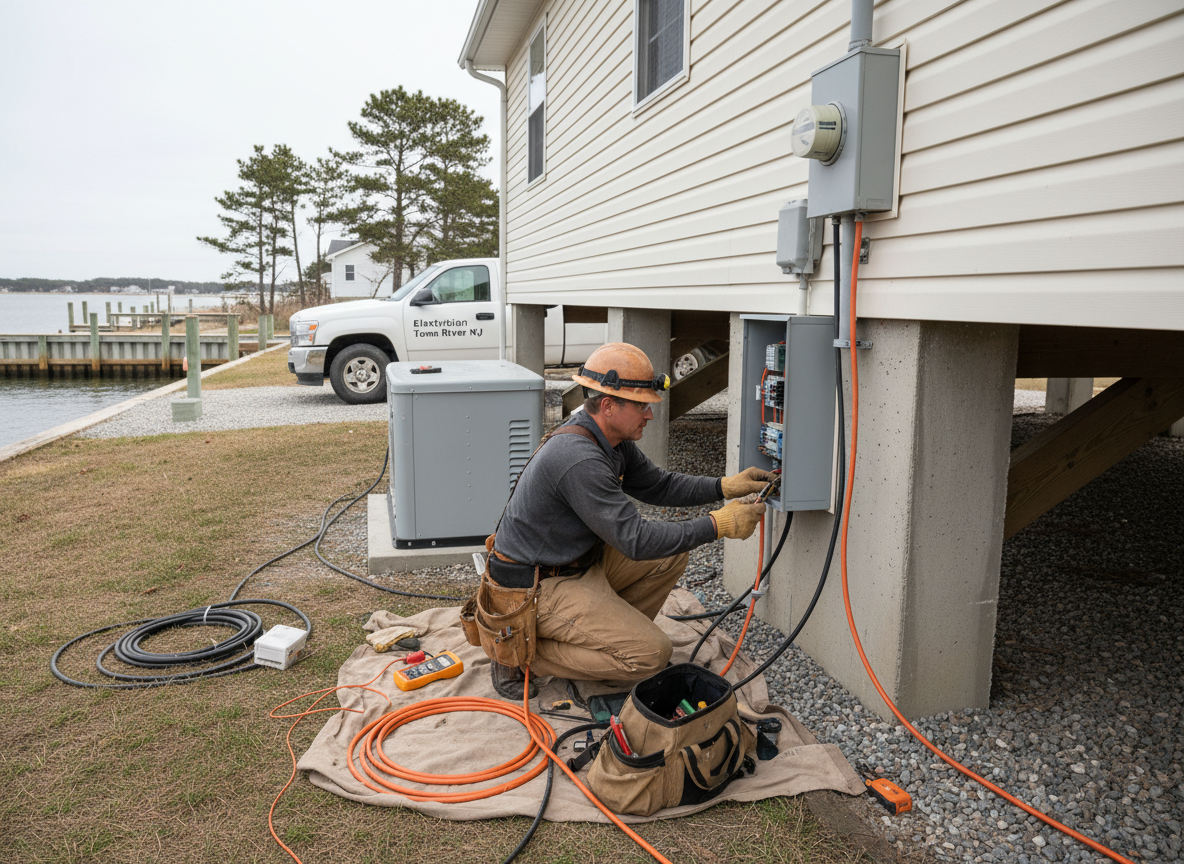
Generator installation is the process of sizing, siting, wiring and permitting a backup power system so your house runs safely when Jersey Central Power and Light goes down. Electrician Toms River NJ installs permanently mounted standby generators with automatic transfer switches, and wires portable generator inlets with manual transfer switches or panel interlock kits. Every job starts with a load calculation, not a guess. We measure the actual service size, count the fixed appliances, look at well pumps, sump pumps, septic grinder pumps, air handlers, condensers and electric water heaters, then match the generator to the loads you genuinely need instead of the loads a brochure assumes.
The sizing conversation matters more than the brand conversation. A 22 kW air cooled standby unit on a 200 amp service will typically carry a whole Toms River ranch including central air, provided the load calculation supports it and any large motor loads are managed with a soft starter. A 10 kW to 14 kW unit paired with a load shed module can cover essentials in a smaller Holiday City or Silver Ridge Park home on a 100 amp service. Portable setups are a different animal. A 7,500 watt portable feeding a 10 circuit manual transfer switch, or an inlet with a listed interlock kit at the load center, is a legitimate solution when budget matters, but you are choosing circuits by hand and refueling every several hours.
Transfer equipment is where corners get cut and where we do not. An automatic transfer switch senses the loss of utility voltage, starts the generator, waits out a stabilization delay, then transfers the load and returns it when JCP&L power is confirmed back. A manual transfer switch does the same isolation with a human at the handle. An interlock kit is a mechanical plate on the load center that makes it physically impossible to close the generator breaker and the main breaker at the same time. All three prevent backfeed onto the utility drop. What is never acceptable is a suicide cord into a dryer receptacle, which energizes the service conductors and can kill a lineworker restoring your street.
Toms River drives generator demand harder than most of New Jersey. Nor'easters, hurricane remnants and coastal wind events knock out overhead distribution across Silverton, Snug Harbor, Gilford Park and the barrier island, and restoration on the peninsula can lag the mainland. Sandy taught this town what a week without power costs a house with a sump pit and a septic pump. Natural gas is available across much of the mainland, which makes a standby unit simple: no tank, no refueling, no fuel degradation. Where gas is not on the street, propane is the fallback, which means siting a 250 or 500 gallon tank with its own clearances, a regulator sized for the generator's BTU draw at full load, and a tank fill route a truck can actually reach.
Placement is a code problem and a neighbor problem at the same time. Manufacturers publish minimum clearances from the structure, and the New Jersey Uniform Construction Code enforces separation from operable windows, doors and any fresh air intake so exhaust cannot be drawn back inside. The unit also has to keep working clearance from the meter and the service disconnect, sit on a level composite or poured pad, and not block egress or a gas meter. On flood zone lots in Ortley Beach, Shelter Cove and the lagoon streets, the generator and its transfer equipment go above base flood elevation, which usually means an engineered platform or a raised pad rather than a slab at grade. Salt air argues for a corrosion resistant enclosure and stainless hardware.
Permits are not optional. Electrician Toms River NJ files the electrical permit with the Toms River Township Building Department, and a plumbing permit accompanies the gas piping where required. The work is inspected under the electrical subcode of the New Jersey Uniform Construction Code, which follows the NEC. The inspector will look at the generator branch circuit and feeder conductors, the transfer switch listing and its neutral handling, the grounding electrode conductor and bonding, whether the generator is a separately derived system, the overcurrent protection at both ends, conduit method and support, working clearance at the enclosure, and the disconnect labeling and arc flash warning. Elevation certificates come into play on flood zone lots. Rough inspection covers concealed wiring; final inspection includes an operational transfer test.
The failure modes show up months later, not on install day. Undersized gas piping is the most common one: the generator runs fine on a no load test and then drops out under load because the pressure sags at the regulator, and everyone blames the generator. Neutral bonding on an automatic transfer switch is the second: a switched neutral system wired as a solid neutral, or the opposite, produces nuisance GFCI tripping and a grounding path that will not pass. Locked rotor inrush from a condenser or a well pump will stall a marginally sized unit unless a soft starter is fitted. Batteries fail quietly, so a unit that never exercises will not start when the wind comes up. And on the water, corrosion attacks the control board terminals and the flexible conduit whip long before it touches the engine.
Technician insight
What catches people out on generators in Toms River is almost never the engine. It is undersized gas piping, so the unit sails through a no load exercise and then drops out a few minutes into a real outage because the pressure sags at the regulator. The second one I find constantly is neutral handling at the transfer switch, wired solid when the system calls for a switched neutral, which shows up later as nuisance GFCI tripping. On the lagoon streets I also check the battery and the control board terminals every visit, because salt air eats those long before it touches the engine.
Silverton Ranch Whose Standby Unit Quit Under Load
A 1960s slab ranch in Silverton had a standby generator that ran its weekly exercise fine but shut down a few minutes into every real outage. Testing under load showed the gas pressure at the generator regulator falling below the manufacturer's minimum as soon as the condenser and the well pump picked up, and the supply piping was one size too small for the BTU draw at full output. The gas contractor upsized the run while we re-terminated a loose feeder lug at the transfer switch and corrected the neutral arrangement. A full load transfer test then held voltage and frequency through several air conditioning cycles, and we reset the exercise timer before leaving.
Generator Installation Services We Offer
✓Whole House Standby Generator Installation
Permanently mounted air cooled or liquid cooled units wired to an automatic transfer switch. Includes pad, fuel connection coordination, load calculation and permitted inspection.
✓Automatic Transfer Switch Installation
Service rated or load side transfer switches with utility sensing, start signal and adjustable transfer delays. Sized to the service and wired for correct neutral handling.
✓Manual Transfer Switch Installation
A 6 to 12 circuit switch panel next to the load center with a power inlet box outside. You select which circuits run and start the generator by hand.
✓Generator Interlock Kit Installation
A listed mechanical interlock plate fitted to the existing load center plus a backfeed breaker and exterior inlet. A lower cost path to safe portable generator use on a modern panel.
✓Generator Inlet Box and Feeder Wiring
Weather rated inlet receptacle, corrosion resistant enclosure and the conduit run back to the panel. Sized for the generator's output receptacle and cord rating.
✓Generator Load Calculation and Sizing
A documented calculation of connected and demand load, including motor inrush, to select generator capacity and decide whether load shedding is required.
✓Load Shed Module and Smart Management
Devices that drop or stagger air conditioning and electric water heating during peak generator demand, letting a smaller unit cover a larger house.
✓Generator Relocation and Flood Zone Elevation
Moving an existing generator and transfer equipment above base flood elevation on raised and rebuilt coastal properties, with new pad, conduit and support.
How it works
- 1
Site Survey And Load Calculation
We measure the existing service, inventory the fixed appliances and motor loads, and run the calculation that determines generator size and transfer switch rating.
- 2
Placement, Fuel And Permit Filing
We fix the location against clearance rules, flood elevation and fuel routing, then file the electrical permit with the Toms River Township Building Department.
- 3
Pad, Set And Wire
The pad goes in, the unit is set and leveled, the fuel line is connected and pressure checked, and the transfer switch, feeders and control wiring are installed.
- 4
Commissioning And Final Inspection
We run a full load transfer test, set the exercise schedule, label the disconnects, and meet the inspector for the final under the New Jersey Uniform Construction Code.
Pricing
Generator cost moves on four things: capacity, transfer equipment, fuel and site. An interlock kit with an inlet on an existing modern panel sits at the low end of the range because the panel already does the work. A portable plus a manual transfer switch is a step up. A standby unit with an automatic transfer switch is a larger project, and within that, going from an essentials circuit switch to a service rated whole house switch adds real cost. Fuel matters: a natural gas tap in the yard is cheaper than setting a propane tank and running underground line. Site work is the wild card. Long conduit runs, a service upgrade the generator forces, rock or high water table under the pad, a raised platform above base flood elevation, or a panel that needs replacing before a transfer switch can land will all move the number. We price after the site survey, never over the phone.