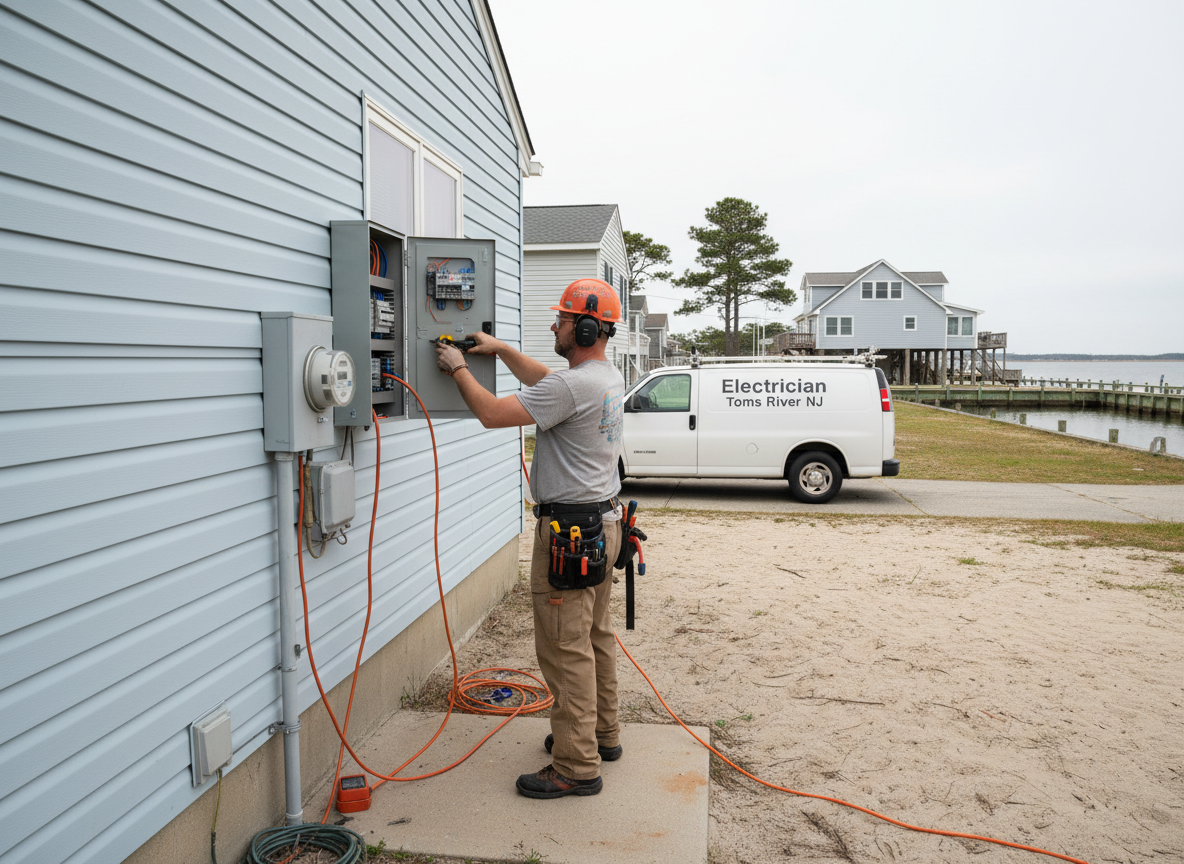
An EV charger installation is a dedicated 240 volt branch circuit run from the service panel to a hardwired charging station or a NEMA 14-50 receptacle. Most residential Level 2 units draw 32 to 48 amps continuous, which requires a 40 to 60 amp circuit sized at 125 percent of the continuous load. Electrician Toms River NJ is a licensed and insured, owner operated electrical contractor in Toms River, New Jersey. The first step is never the garage wall. It is a load calculation against the existing service, since the charger is often the largest single load in the house and a 100 amp service will frequently not accept it without either a capacity increase or a load management device.
Local conditions shape the install more than the charger brand does. Many Toms River homes still run 100 amp services, particularly in Holiday City and Silver Ridge Park, where the panel sits in a slab on grade ranch with few spare spaces. Homes raised after Sandy have panels relocated above base flood elevation, sometimes on the upper level, which puts a long feeder between the panel and a ground level parking area. Detached garages and carports mean a trench and an underground feeder. Bayfront and barrier island driveways expose outdoor units to salt air, so enclosure rating and hardware selection matter, and outdoor terminations need to be treated as wet locations.
EV charger circuits require an electrical permit from the Toms River Township Building Department and inspection under the New Jersey Uniform Construction Code, with the electrical subcode based on the NEC. Inspectors check circuit and conductor sizing against the charger nameplate, the continuous load calculation, GFCI protection where a receptacle is used, the disconnecting means, mounting height, and the working clearance at the panel. Outdoor and garage installations are checked for weather rating and physical protection from vehicle impact. Where a load management system is used to avoid a service upgrade, that equipment is part of the inspected installation and has to be documented.
The edge cases are worth knowing before you buy hardware. A NEMA 14-50 receptacle install requires GFCI protection under current code, which adds cost and occasionally causes nuisance tripping with certain chargers, so hardwiring at 48 amps is often the cleaner path. Aluminum feeders to a detached garage need terminations rated for aluminum and proper antioxidant treatment. Long runs cause voltage drop, which shows up as slower charging rather than as a fault, so conductor size sometimes goes up a step for distance alone. Condominium and townhouse installations in Toms River add an association approval and a metering question. And utility and state incentive programs change, so current terms should be confirmed with JCP&L and the state program directly rather than assumed.
Technician insight
Most people call me having already bought the charger, and the first honest answer is that the garage wall is not where this starts. The charger is usually the largest single load in the house, so I run the load calculation against the existing service first, and on the 100 amp services still common in Holiday City and Silver Ridge Park the answer is often a load management device or a capacity increase before anything gets mounted. The other one that catches people is the receptacle: a NEMA 14-50 needs GFCI protection under current code, and some chargers trip on it without a real fault, so hardwiring at 48 amps is frequently the cleaner path. On long runs I also size the conductors up a step, because voltage drop shows up as slow charging rather than as a fault and people assume the charger is defective.
Detached Garage Charger in North Dover
The owners of a 1980s two story colonial in North Dover wanted a Level 2 charger at a detached garage set back from the house. The load calculation against the existing 200 amp service showed capacity for a 48 amp unit, so no service work was needed, but the distance from the panel was long enough that voltage drop would have slowed charging. We ran an underground feeder in conduit at the required burial depth to a small subpanel at the garage, with the conductors sized up a step for the distance, then hardwired the charger on a 60 amp circuit with a disconnecting means at the unit. The installation was permitted through the Toms River Township Building Department, and at final we tested actual charging current under load rather than just confirming voltage.
EV Charger Installation Services We Offer
✓Level 2 Home Charger Installation
Dedicated 240 volt circuit and mounted charging station in a garage, carport or driveway, sized to the unit's continuous load rating.
✓NEMA 14-50 Receptacle Installation
A 50 amp receptacle with the GFCI protection current code requires, for portable or plug in chargers, including proper box and weather rating outdoors.
✓Hardwired 48 Amp Charger Circuits
Direct wired installation on a 60 amp circuit for faster charging, avoiding receptacle GFCI compatibility issues that some chargers have.
✓Load Management and EVEMS Installation
Energy management devices that let a charger share capacity with existing loads, which can avoid a service upgrade on a 100 amp house.
✓Panel Capacity Evaluation and Load Calculation
A written calculation showing whether the existing service can carry the charger, and what the alternatives are if it cannot.
✓Detached Garage and Driveway Feeds
Trenching, conduit and underground feeders to detached garages, carports and driveway pedestals, with correct burial depth and conductor sizing.
✓Outdoor and Coastal Charger Mounting
Weather rated enclosures, corrosion resistant hardware and wet location terminations for units exposed to salt air near the bay and the barrier island.
✓Commercial and Multi Unit Charging
Charger installations for offices, retail, marinas and multi unit properties, including circuit layout, metering considerations and parking area protection.
How it works
- 1
Charger Specification and Load Calculation
We confirm the unit's continuous amperage and nameplate rating, then run the load calculation against your existing service to size the circuit and confirm capacity.
- 2
Route and Mounting Plan
We set the charger location and cable reach against where the vehicle actually parks, then plan the conduit or cable route, including trenching for detached structures.
- 3
Permit and Installation
The permit is filed with Toms River Township, the breaker and conductors are installed and the unit is mounted, with a disconnecting means where the installation requires one.
- 4
Test, Commission and Inspect
We verify voltage, rotation of the ground and neutral terminations, GFCI function and actual charging current under load, then meet the inspector for final approval.
Pricing
Distance and panel capacity set the price. A charger mounted on the garage wall directly behind the panel is a short circuit run and a modest job. The same charger 80 feet away across a finished basement, or in a detached garage requiring a trench and an underground feeder, costs considerably more in conductor, conduit and labor. If the load calculation shows the service cannot carry the charger, you are choosing between a load management device and a service upgrade, and that choice is the largest single variable. GFCI breakers for receptacle installs, larger conductors to control voltage drop on long runs, permit fees and coastal rated exterior hardware all add. Simple attached garage installs commonly land in the high hundreds to low thousands, while trenched or upgrade dependent installs run well beyond that.