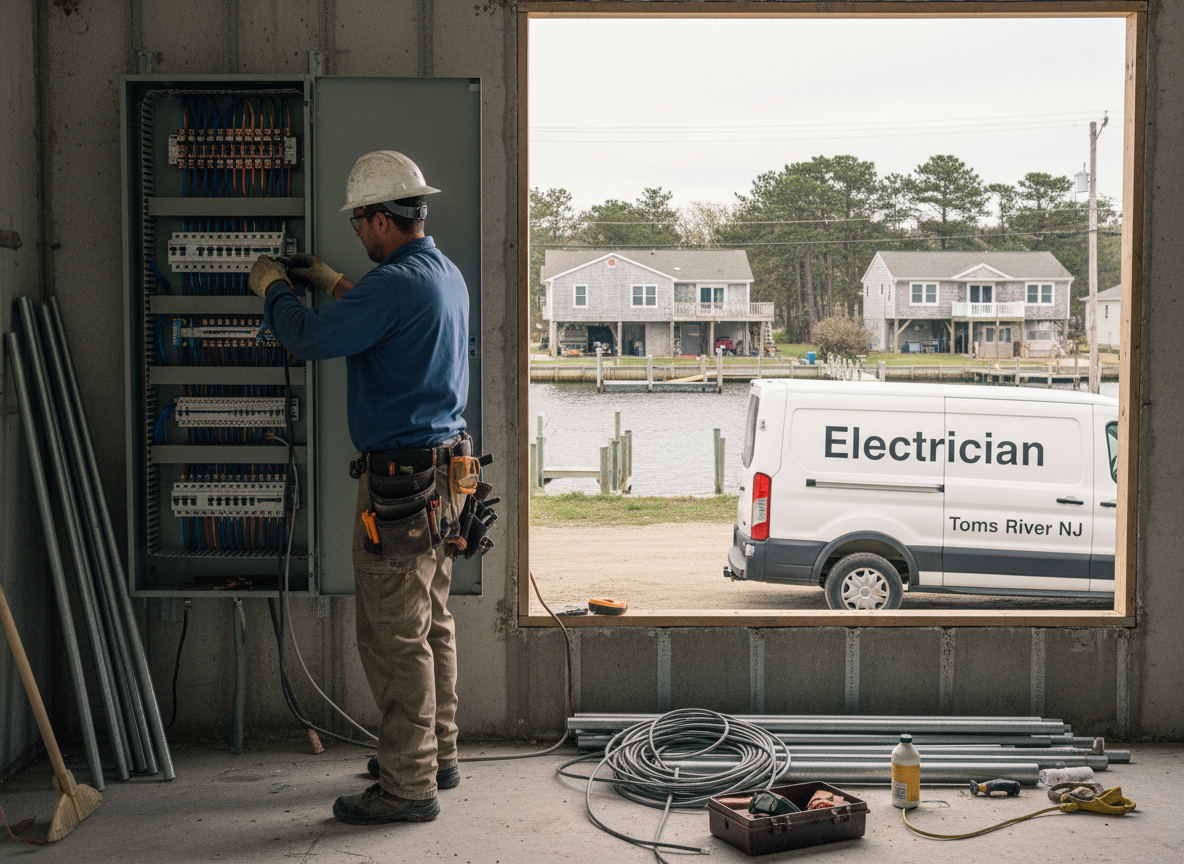
Commercial electrical work is built around continuity and load. The service is often three phase, 208Y/120 or 480Y/277, feeding panelboards, distribution equipment, rooftop units, refrigeration, compressors and lighting that a business cannot operate without. Electrician Toms River NJ is a licensed and insured, owner operated electrical contractor serving commercial property in Toms River, New Jersey. Diagnosis on a commercial call means reading the one line if it exists, then verifying it against what is actually installed, because tenant turnover leaves feeders, abandoned conduit and mislabeled panelboards behind. We check phase balance, voltage under load and termination temperature before touching anything.
Toms River commercial property has its own patterns. The Route 37 retail corridor and the strip plazas around it are full of spaces that have been subdivided and re subdivided, so a single service can feed tenants whose loads have nothing to do with the original design. Restaurants and food service add hood equipment, refrigeration and makeup air. Marinas and bayfront businesses fight salt air on every outdoor disconnect, pedestal and dock circuit. Seasonal traffic in summer means a building sits near peak load for three months and near idle for six, which hides problems until the first hot week in June.
Commercial work in Toms River requires permits and inspection through the Toms River Township Building Department under the New Jersey Uniform Construction Code, with the electrical subcode based on the NEC. Tenant fit outs typically involve a plan review, rough inspection with ceilings still open, and a final tied to the certificate of occupancy or continued occupancy. Emergency and exit lighting, egress illumination and required receptacle and disconnect locations are all inspected items. Working clearance in front of panelboards and switchgear is checked and is one of the more common reasons a final gets held, because tenants store product in the electrical room.
The problems specific to commercial buildings are usually the ones nobody owns. Shared neutrals in a 208Y/120 system running heavy nonlinear load will run hot even when every phase conductor looks fine. Abandoned circuits left energized behind a demised wall are a real hazard during demolition. Panelboards fed from an upstream disconnect in another tenant's space make shutdowns a negotiation. Aluminum feeders terminated without proper compound or torque show up as heat at the lugs years later. And on marina and bayfront property, we routinely find corroded pedestal wiring where the grounding and bonding path has quietly opened up.
Technician insight
On commercial calls in Toms River, the thing that catches owners out is that nobody owns the history of the building. A space on the Route 37 corridor gets subdivided, then subdivided again, and I open a panelboard whose directory has nothing to do with what it actually feeds. The other one is the seasonal swing: a building sits near idle for six months, so a hot lug or an unbalanced phase stays hidden until the first genuinely hot week in June, when the load arrives all at once. I also check working clearance early, because a final gets held for stock stacked in front of the panelboard more often than for anything I wired.
Strip Plaza Feeder Heat in East Dover
A tenant in a 1980s strip plaza in East Dover reported lights dimming and a warm smell in the back of house whenever the rooftop unit and the walk in refrigeration ran together. A load reading during operating hours showed the three phases badly out of balance and one feeder lug running hot enough to discolor the insulation. Behind the deadfront we found aluminum feeder conductors terminated without antioxidant compound and never torqued to spec, plus two abandoned circuits from a prior tenant still energized behind a demised wall. We re terminated the feeder with rated lugs and documented torque, redistributed branch circuits to balance the phases, removed the abandoned conductors, and issued a corrected panelboard directory. The work ran overnight so the tenant did not lose a trading day.
Commercial Electrician Services We Offer
✓Tenant Fit Out and Buildout Wiring
Full electrical for a new tenant space: panelboard, feeder, branch circuits, lighting, data rough, and coordination with the general contractor and the inspector.
✓Three Phase Service and Panelboard Work
New or upgraded 208Y/120 and 480Y/277 services, distribution panelboards, feeders and disconnects, coordinated with JCP&L for the service connection.
✓Commercial LED Lighting Retrofits
Replacing fluorescent troffers, high bays and exterior wall packs with LED, including driver and control compatibility, occupancy sensing and photocell control.
✓Exit, Emergency and Egress Lighting
Installation, testing and correction of exit signs, emergency battery units and egress path illumination that inspectors and fire officials check directly.
✓Parking Lot and Building Exterior Lighting
Pole bases, underground feeds, wall packs and photocell or timeclock control, using corrosion resistant hardware near the bay and the barrier island.
✓Restaurant and Kitchen Equipment Circuits
Dedicated circuits and disconnects for hoods, makeup air, walk in refrigeration, fryers and warewashers, plus hood interlock and shunt trip wiring.
✓Preventive Maintenance and Thermal Checks
Scheduled inspection of terminations, lug torque, phase balance and load readings so a failing connection is found before it takes a panel out.
✓Marina, Dock and Shore Power Wiring
Pedestals, boat slip circuits, GFCI and ground fault protection, and bonding on waterfront commercial property exposed to salt air.
How it works
- 1
Site Survey and Load Reading
We meter the existing service under real operating load, check phase balance and identify what each panelboard actually feeds before proposing anything.
- 2
Scope, Shutdown Plan and Permit
Work is scoped around business hours, with a written shutdown window if power must drop, and permits filed with Toms River Township ahead of mobilization.
- 3
Install With Inspections Staged
Rough is set for when ceilings and walls are still open, so conduit, supports and box locations can be verified without demolition later.
- 4
Test, Label and Turn Over
Circuits are megger or continuity tested where warranted, panelboards are directoried, and we walk the space with the owner and the inspector for final sign off.
Pricing
Commercial pricing tracks three things: the size of the conductors, the difficulty of the pathway and when the work has to happen. A lighting retrofit in an open ceiling warehouse is fast. The same fixture count in a finished medical office with a hard lid ceiling and a no dust requirement is a different job. Feeder work priced at 4 AWG and feeder work priced at 350 kcmil are not comparable, and copper pricing moves. Night and weekend work to avoid a shutdown adds labor cost but usually saves the tenant more than it costs. Plan review, permit fees, inspection trips, existing conditions that fail inspection, and coordination with JCP&L for a service change all extend the timeline and the number. We price after a site survey and a load reading, never off a phone description.