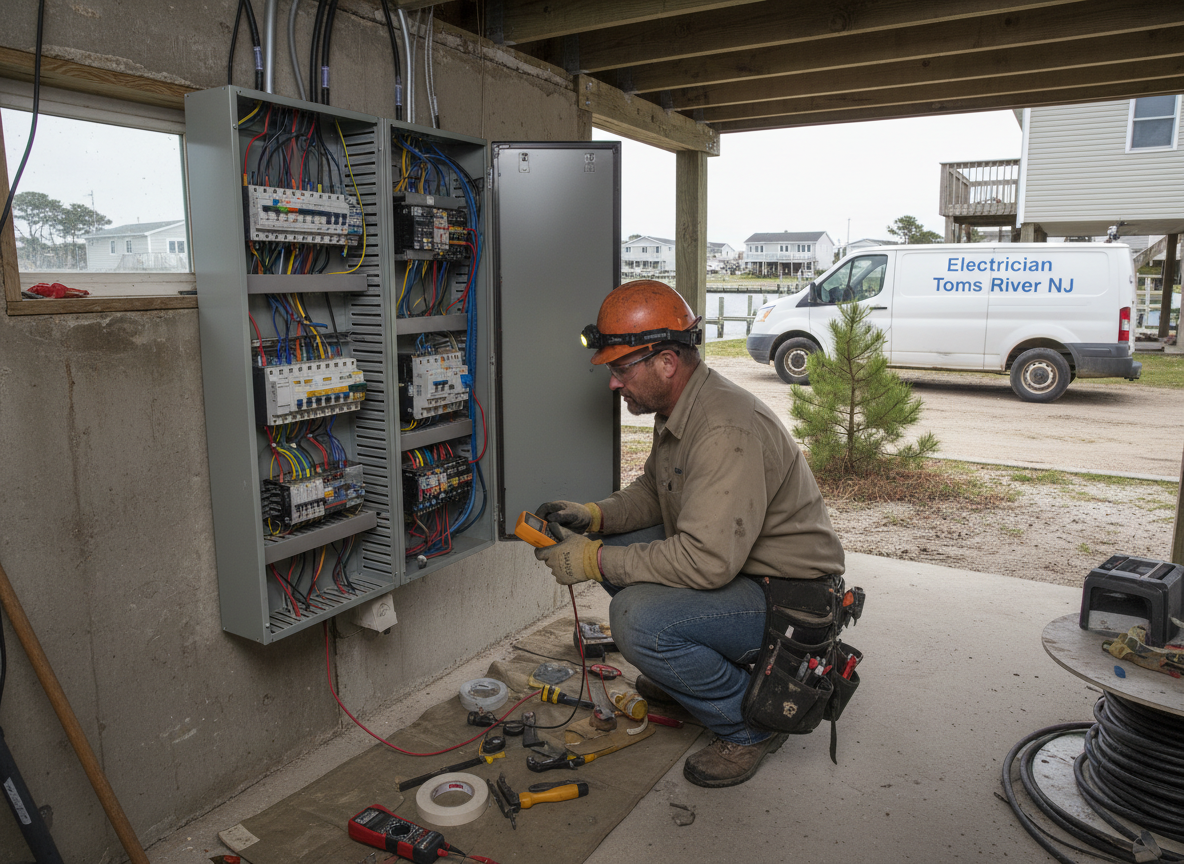
An electrical safety inspection is a preventive, whole home condition assessment: the panel, the branch circuits, the terminations, the grounding and bonding system, and the protective devices, checked before anything fails. Electrician Toms River NJ performs these on a schedule rather than in response to a transaction. Nothing has to be wrong to justify one. The work is measurement based. We record temperature at terminations under load, verify torque on lugs and breaker screws to manufacturer specification, test every GFCI and AFCI device for actual trip response rather than button feel, and check ampacity against the breaker protecting each circuit.
The assessment moves outward from the service. Panel interior first: busbar condition and any pitting or discoloration, breaker seating, double tapped breakers, conductor insulation condition where it enters, neutral and ground bar separation in subpanels, and whether the panel is a make with a known failure history. Then grounding electrode conductor, ground rods and water pipe bonding. Then the branch circuits: we sample receptacles and switches for backstab failure, loose device screws, reversed polarity, open grounds and heat marks, and we check junction boxes in attics, crawl spaces and garages for open splices. Finally load: we look at how much the service is actually carrying against its rating, which is where 100 amp services in modernized homes come up short.
Toms River housing makes these assessments worthwhile in specific ways. Holiday City and Silver Ridge Park homes were built mainly in the 1960s through the 1980s, so a typical inspection there finds a 100 amp service now carrying central air and a modern kitchen, aluminum branch wiring at 15 and 20 amp circuits, original receptacles losing grip tension, and Federal Pacific Stab-Lok or Zinsco panels. Homes near downtown and the river can still have cloth insulated wiring, knob and tube remnants in attics, and fuse panels. On the bay and lagoon side, salt air corrodes meter bases, outdoor disconnects, weatherheads and exterior GFCI devices from the outside in, which is invisible until a cover comes off. Slab on grade construction means every retrofit runs through the attic, so attic junctions accumulate over decades.
Preventive work still intersects with the code. Nothing about an inspection itself requires a permit, but corrections often do. Panel replacement, service upgrades, new circuits, AFCI and GFCI retrofits that involve rewiring, and grounding electrode system work are all filed with the Toms River Township Building Department and inspected under the electrical subcode of the New Jersey Uniform Construction Code. A useful principle applies here: existing wiring that was compliant when installed is generally not a violation simply because the code changed, but once a circuit is extended or altered, current requirements apply to that work. That is why an inspection separates findings into genuine safety defects and code updates that make sense to do while a wall is already open.
The findings that matter most are rarely the obvious ones. A breaker that reads normal at rest can run 40 degrees hot under load because the lug was never torqued, and only a thermal check under load finds it. GFCI receptacles have a finite life, and older ones can pass the test button while failing to trip on an actual ground fault, which is why we test with a load and a fault simulator. Aluminum branch wiring overheats at the device termination, so the risk sits behind cover plates, not in the walls. Double tapped neutrals under one screw are extremely common and cause intermittent faults that nobody can reproduce. A subpanel with a bonded neutral, common in additions and converted garages, puts current on the equipment grounding conductor continuously and passes a casual look. And a whole house surge protective device is worth more in a town that takes this many storm related utility events than most homeowners assume.
Technician insight
What catches people out on a safety inspection is that the findings that matter are almost never visible. A breaker lug that was never torqued reads perfectly normal cold and runs 40 degrees hot under load, and only a thermal reading with the circuit working finds it. The same goes for GFCI devices: the test button checks the internal test circuit, and I regularly find exterior and pool area devices on Toms River waterfront properties that pass the button and will not trip on a real fault. In the 1960s and 1970s ranches out in Holiday City and Silver Ridge Park, the aluminum branch wiring overheats at the device screw behind the cover plate, not out in the wall, which is exactly why we take the plates off.
Scheduled Assessment On A Holiday City Ranch
A slab on grade ranch in Holiday City from the early 1970s was booked for a routine inspection with no complaint from the owner. With the panel cover off, thermal readings under load showed one breaker lug running well above the rest, and a kitchen circuit termination on aluminum branch wiring was heat marked behind the receptacle cover plate. Testing also found two exterior GFCI receptacles that passed the test button but would not trip on a simulated fault, and a double tapped neutral under a single screw at the bar. We torqued and re-terminated the panel connections, pigtailed the affected aluminum terminations with listed connectors, replaced the failed GFCI devices, and gave the owner findings ranked by risk with a reinspection interval.
Electrical Safety Inspections Services We Offer
✓Whole Home Electrical Condition Assessment
A room by room and circuit by circuit evaluation of wiring, devices, panel and grounding, documented with findings ranked by risk.
✓Panel and Load Center Evaluation
Interior inspection for busbar damage, breaker seating, double taps, conductor condition and known problem panels such as Federal Pacific Stab-Lok and Zinsco.
✓Thermal Imaging and Torque Verification
Temperature readings at terminations under load and torque checks on lugs and breaker screws to find connections heating before they fail.
✓AFCI and GFCI Device Testing
Functional trip testing of arc fault and ground fault devices with an actual fault simulation, not just the test button, plus retrofit recommendations.
✓Grounding and Bonding System Verification
Checking the grounding electrode conductor, ground rods, water pipe and gas bonding, and neutral to ground separation in every subpanel.
✓Aluminum Branch Wiring Assessment
Identifying aluminum circuits, inspecting terminations for heat damage, and scoping remediation with listed connectors such as AlumiConn.
✓Older Home Wiring Survey
Documenting cloth insulated wiring, knob and tube remnants, ungrounded circuits and fuse panels in early housing near downtown and the river.
✓Coastal Corrosion Inspection
Removing covers on meter bases, outdoor disconnects, exterior receptacles and weatherheads on bayfront and lagoon properties to assess salt air damage.
✓Surge Protection and Load Capacity Review
Evaluating service capacity against actual demand and recommending whole house surge protection at the service.
How it works
- 1
History And Walkthrough
We ask what has been added since the house was built, then walk the property to map panels, subpanels, outbuildings and any obvious retrofit work.
- 2
Panel And Service Assessment
Covers come off. We inspect the busbar and terminations, take thermal readings under load, verify torque and check grounding and bonding.
- 3
Circuit And Device Testing
We test receptacles, switches, GFCI and AFCI devices, sample junction boxes in attics and crawl spaces, and identify aluminum or deteriorated conductors.
- 4
Ranked Report And Plan
You receive findings sorted into immediate safety items, wear items to schedule, and optional upgrades, with a suggested reinspection interval.
Pricing
A safety inspection is priced on the size of the property and the number of panels and circuits, not on what we find. A single family home with one service and one panel is the baseline. Cost increases with a second panel, a subpanel in a detached garage, an in law suite, or a waterfront property with dock, boat lift and outdoor circuits. Thermal and torque verification takes time under load and adds to the visit, and it is the part that most often earns its cost. Homes with aluminum branch wiring or original 1960s and 1970s devices take longer because more terminations need to be opened and looked at. Corrections are quoted separately after the report, so you decide what to do now and what to schedule.