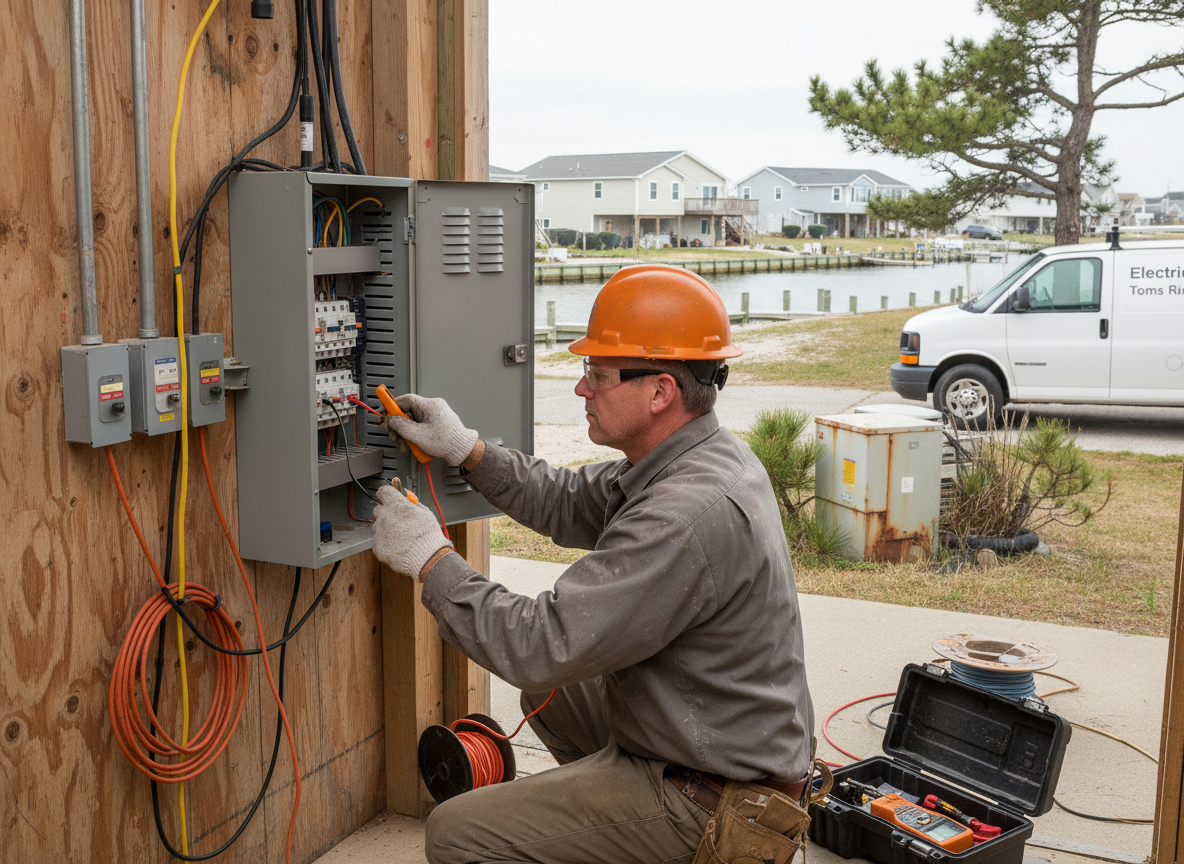
An electrical inspection is a documented evaluation performed because something requires it: a house is being sold, a certificate of occupancy is needed, a rental certificate is due, an insurance carrier has flagged the panel, or the Toms River Township Building Department has issued a notice on unpermitted work. Electrician Toms River NJ inspects the service and the branch circuits, then produces written findings that name each deficiency, the code basis for it and what the correction involves. The point is a document someone else will act on, so it is specific, not general. Vague reports stall closings.
The walkthrough follows the power. We start at the service drop or lateral, the meter base, the service mast and weatherhead, then the main disconnect and the service panel: amperage rating, busbar condition, breaker sizing against conductor ampacity, double taps, missing knockouts, oversized fuses in a fuse panel, and whether the panel is a Federal Pacific Stab-Lok or Zinsco unit that insurers routinely refuse. We verify the grounding electrode conductor, ground rods, and water pipe bonding. Then GFCI protection at kitchens, baths, laundry, garage, exterior and any pool equipment; AFCI protection where the scope requires it; smoke and carbon monoxide devices; and open junction boxes, backstab failures, reversed polarity and ungrounded three prong receptacles throughout.
Toms River generates a specific set of findings. Holiday City and Silver Ridge Park sales turn up 100 amp services, aluminum branch wiring on 15 and 20 amp circuits, original 1960s and 1970s receptacles, and panels insurers will not write. Older homes near downtown and the river produce cloth insulated wiring, fuse panels and two prong ungrounded outlets, all of which a buyer's inspector will call out. Post Sandy rebuilds in Ortley Beach, Silverton and the lagoon streets bring their own issue: work done fast during the rebuild that never got a final inspection, or service equipment relocated for flood elevation with no permit record. On a sale, an open permit is often the item that actually delays the closing, not the wiring itself.
Toms River Township Building Department issues electrical permits and schedules the municipal inspections that close them, and the work is judged under the electrical subcode of the New Jersey Uniform Construction Code, which follows the NEC. It is worth being clear about roles. A municipal electrical subcode official performs the official inspection tied to a permit. A licensed contractor performs the evaluation that tells you what a property needs, corrects it, pulls the permit and then meets that official for the rough or final. When a sale contract, a lender or an insurer asks for an electrician's report, they are asking for the second thing, and if corrections follow, the permit and municipal inspection follow with them.
The edge cases are where deals get stuck. A property with an open permit from years ago may need the original scope reinspected before a new one can be closed, and if the wiring is concealed, that can mean opening walls. Buyers frequently misread a report: an ungrounded two prong outlet is not automatically a violation, since it was compliant when installed, but a three prong receptacle installed on an ungrounded circuit without GFCI protection and correct labeling is. Aluminum branch wiring is not a mandatory replacement either, but insurers may require pigtailing with a listed connector such as AlumiConn or COPALUM. Seasonal rentals near the beach also carry a separate rental certificate cycle, and a report written for a sale will not necessarily satisfy it.
Technician insight
What catches people out on inspections in Toms River is that the open permit delays the closing more often than the wiring does. I pull the permit history early, because a job that was never given a final years ago can mean the original scope has to be reinspected, and if the wiring is concealed that can mean opening walls. The other one is misreading the report: a two prong ungrounded outlet was compliant when it was installed, but a three prong receptacle dropped onto an ungrounded circuit with no GFCI protection and no labeling is a real finding. And on Holiday City and Silver Ridge Park sales I expect the panel itself to be the insurance problem before anything else is.
Pre Sale Findings In A Silver Ridge Park Ranch
A 1970s single story ranch in Silver Ridge Park was under contract when the buyer's carrier refused to write a policy on the panel. The walkthrough confirmed a panel of a make insurers routinely decline, aluminum branch wiring on several 15 and 20 amp circuits, and a finished garage circuit added at some point with no permit record. We wrote itemized findings with the code basis for each item, pigtailed the aluminum connections to copper with listed connectors, replaced the panel and filed the permit with the Toms River Township Building Department. The garage circuit was brought into compliance and inspected at the same final, which cleared both the carrier and the closing.
Electrical Inspection Services We Offer
✓Pre Sale Electrical Inspection
A seller side evaluation before listing so deficiencies are found and corrected before a buyer's inspector writes them into a negotiation.
✓Buyer Due Diligence Electrical Evaluation
An independent review during attorney review or the inspection period, focused on what the home inspection report flagged and what it will actually cost to correct.
✓Certificate of Occupancy Electrical Requirements
Identifying and correcting the electrical items required for a CO, including smoke and carbon monoxide device placement, GFCI protection and panel labeling.
✓Rental Certificate Electrical Inspection
Evaluation for landlords ahead of a rental certificate cycle on year round and seasonal rental properties, including receptacle, GFCI and alarm requirements.
✓Insurance Required Panel Inspection
Documentation for carriers that have flagged a Federal Pacific Stab-Lok, Zinsco or fuse panel, including a written scope for replacement.
✓Open Permit Research and Close Out
Identifying open or expired electrical permits on a property, determining what the municipality needs to close them, and performing the corrective work.
✓Unpermitted Work Correction and Reinspection
Bringing previously unpermitted additions, finished basements, garages and generator installations into compliance and back through inspection.
✓Written Correction Estimate for Negotiation
An itemized scope and cost breakdown of the flagged electrical items, usable directly in a sale negotiation or a lender conversation.
How it works
- 1
Define The Requirement
We confirm who is asking and why: sale contract, CO, rental certificate, insurer or municipal notice. That determines the scope and the format of the report.
- 2
Service And Circuit Walkthrough
We inspect the meter, service, panel, grounding and bonding, then test receptacles, GFCI and AFCI protection, devices and alarms room by room.
- 3
Written Findings
You receive an itemized report naming each deficiency, its code basis under the New Jersey Uniform Construction Code and the correction required, priced separately.
- 4
Correction, Permit And Reinspection
If you proceed, we file the permit with the Toms River Township Building Department, perform the corrections and meet the inspector for the final.
Pricing
An inspection is priced on property size, service complexity and how much documentation you need. A single family ranch with one panel and no outbuilding is the baseline. Cost rises with square footage, a second panel or subpanel, a detached garage, a rental unit with a separate service, or a waterfront property with dock and boat lift circuits. Pulling permit history and researching open permits takes time and is billed accordingly. The report itself is where the value sits: a short verbal opinion is cheap and useless to a title company, while an itemized written scope with code references is what closings actually run on. Corrections are quoted separately, item by item, so a buyer or seller can decide what to negotiate and what to fix.