2026-08-31 · Nick Petrucci
Why Flood Zone Homes Have Their Panels and Meters Mounted So High
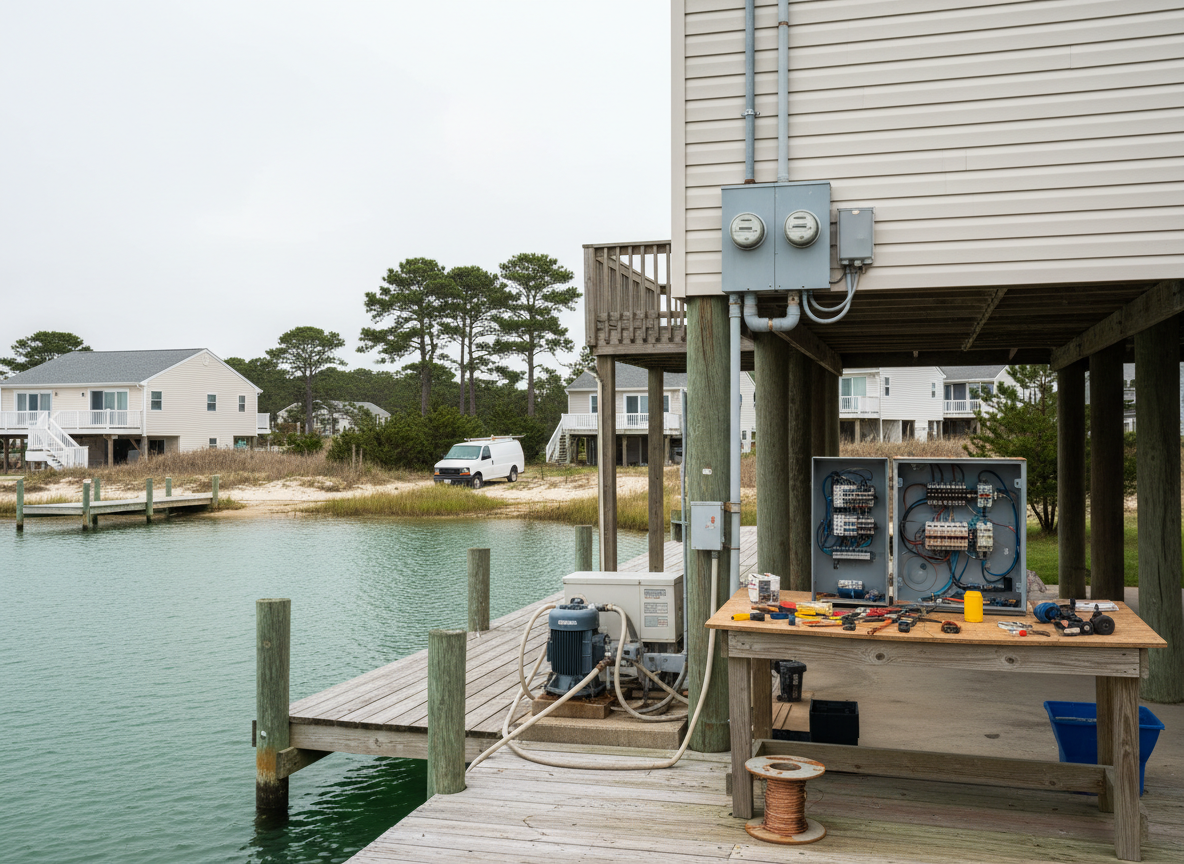
Service equipment in a flood zone is mounted high because the New Jersey Uniform Construction Code requires electrical equipment to be installed above the base flood elevation for the property, with additional freeboard on top of that. On a raised home in a coastal V or AE zone, that pushes meters, disconnects and panels well above the ground floor, sometimes to a second story wall or the top of a piling.
What Base Flood Elevation Actually Means
Base flood elevation, usually written BFE, is the height floodwater is expected to reach in a flood with a 1 percent annual chance. It is expressed as a number of feet above sea level, not above your lawn, which is the first thing that confuses homeowners. A BFE of 9 on a lot whose grade sits at 5 means the design flood reaches 4 feet above your yard.
Freeboard is the safety margin added above BFE. New Jersey has required freeboard above the mapped BFE for new and substantially improved construction in flood hazard areas, which is why the finished elevation of a raised house and its equipment is higher than the flood map number alone would suggest. The design flood elevation is BFE plus that freeboard, and that is the line electrical equipment has to clear.
The rule covers more than the panel. Meter bases, service disconnects, load centers, subpanels, transfer switches, generator connections, receptacles, junction boxes and HVAC disconnects all fall under it. What is permitted below the line is limited and specific: equipment that must be low to do its job, wired so it can be de-energized, with the circuit protection itself kept above elevation.
Why the Rule Exists in Physical Terms
Water does not simply short out a panel and stop there. Salt and brackish floodwater is conductive and it carries silt. It wicks up NM cable through the paper wrap and between conductors, it fills conduit and stays there, and it deposits chloride salts inside enclosures that keep drawing moisture out of the air long after the flood has drained. That is the reason a panel that got wet in 2012 and dried out and appeared to work was still failing years later. The failure mechanism is corrosion at the busbar stabs and the breaker clips, not immediate flashover.
Breakers are worse than the bus. A molded case breaker has a calibrated thermal element and a mechanical latch inside a sealed but not waterproof case. Once silt and salt get in, the trip characteristic is no longer trustworthy. A breaker that will not trip when it should is a fire risk that gives no outward sign. There is no way to inspect or clean the inside of a residential breaker, so submerged breakers get replaced, along with the load center they sat in.
Meters and meter bases fail the same way, and the utility will not reset a meter into a socket that has been underwater. That is the practical reason so many Ortley Beach and Silverton services came back higher after Sandy. It was not only the house that was raised. The service had to be rebuilt anyway, and rebuilding it meant rebuilding it to current elevation requirements.
How to Tell Whether Your Equipment Is Compliant
An electrician sizing this up on site does not start with a tape measure at the panel. The first step is the elevation certificate, which gives the surveyed elevation of the structure and lets you compare real numbers instead of guessing. Without it, everything else is estimation.
After that, the checks are physical:
- Locate the flood zone and BFE for the address. Zone designation and BFE come from the flood map, and the township keeps flood zone requirements attached to the permit review.
- Find the lowest current-carrying component. That is often not the panel. It is a basement receptacle, a boiler disconnect, an old sump circuit junction box or a crawlspace splice.
- Look for evidence of prior submersion. A silt line inside the panel dead front, rust blooming from the bottom of an enclosure upward, a stained neutral bar, corrosion on the ends of the service entrance conductors where they land on the main lugs.
- Check what was actually replaced last time. Panels swapped after a flood while the same wet feeder or the same wet branch circuits were reused are common. The new panel looks fine and the problem is behind it.
- Verify working clearance at the new height. Equipment moved up onto a piling or an exterior wall still needs 30 inches of width, 36 inches of depth and a stable place to stand.
The most common misdiagnosis is calling flood damage a nuisance tripping problem. A GFCI on a circuit that runs through a previously flooded wall will trip on humid days because leakage current through corroded, damp cable is real current, not a defective device. Replacing the GFCI three times solves nothing. Meggering the circuit does.
What to Do About It, and When It Is a Safety Issue
If your equipment sits below the design flood elevation, the practical trigger for moving it is usually another project: a service upgrade, a generator installation, a substantial improvement or a repair after damage. Raising service equipment is permitted work, inspected by the Toms River Township Building Department, and it involves the utility because the meter has to be relocated and reset. Expect the job to include a new mast or riser, new service entrance conductors, a relocated grounding electrode conductor and often new ground rods driven at the new location.
The safety threshold is straightforward. Any equipment that has been submerged should be treated as failed, regardless of whether it is working. Breakers, panels, meter bases, switches, receptacles and any device that got wet are replacement items, not cleaning items. Cable that sat in salt water is replaced back to a dry, verified point. Anything that trips intermittently, smells of ozone, or shows corrosion at a terminal gets looked at now rather than in the spring.
There is also a resilience argument that has nothing to do with code. Equipment high on a wall survives the next storm, and a house whose service comes back the day power is restored is a house you can live in. If you want a straight assessment of where your equipment sits relative to your elevation, Electrician Toms River NJ can walk the property with you.
Frequently Asked Questions
Can I keep my panel in the basement if it never flooded? Often yes. Existing equipment that predates the current requirements is generally allowed to stay until it is replaced or the home undergoes substantial improvement. The requirement attaches to new work and to major projects, so a working, undamaged, code compliant panel installed years ago is not automatically illegal. Replacing it, however, means installing the replacement at the required elevation.
How high does the panel actually have to be? It has to sit above the design flood elevation, which is your base flood elevation plus the required freeboard, not a fixed number of feet off the ground. Two houses on the same street can have different answers because their grade and their BFE differ. The elevation certificate and the flood map for the specific address settle it.
Is a flooded breaker safe once it dries out? No. Drying removes the water but leaves salt and silt inside the mechanism, where corrosion continues on the thermal element and the trip latch. The breaker may still carry load and still feel normal while having lost the ability to trip reliably on overload. Since the internals cannot be inspected or serviced, submerged breakers and the panel they sat in are replaced.
Moving equipment out of harm's way is handled as raising service equipment above base flood elevation.