2026-08-31 · Nick Petrucci
JCP&L Service Drop and Weatherhead: Which Parts Are Yours and Which Belong to the Utility
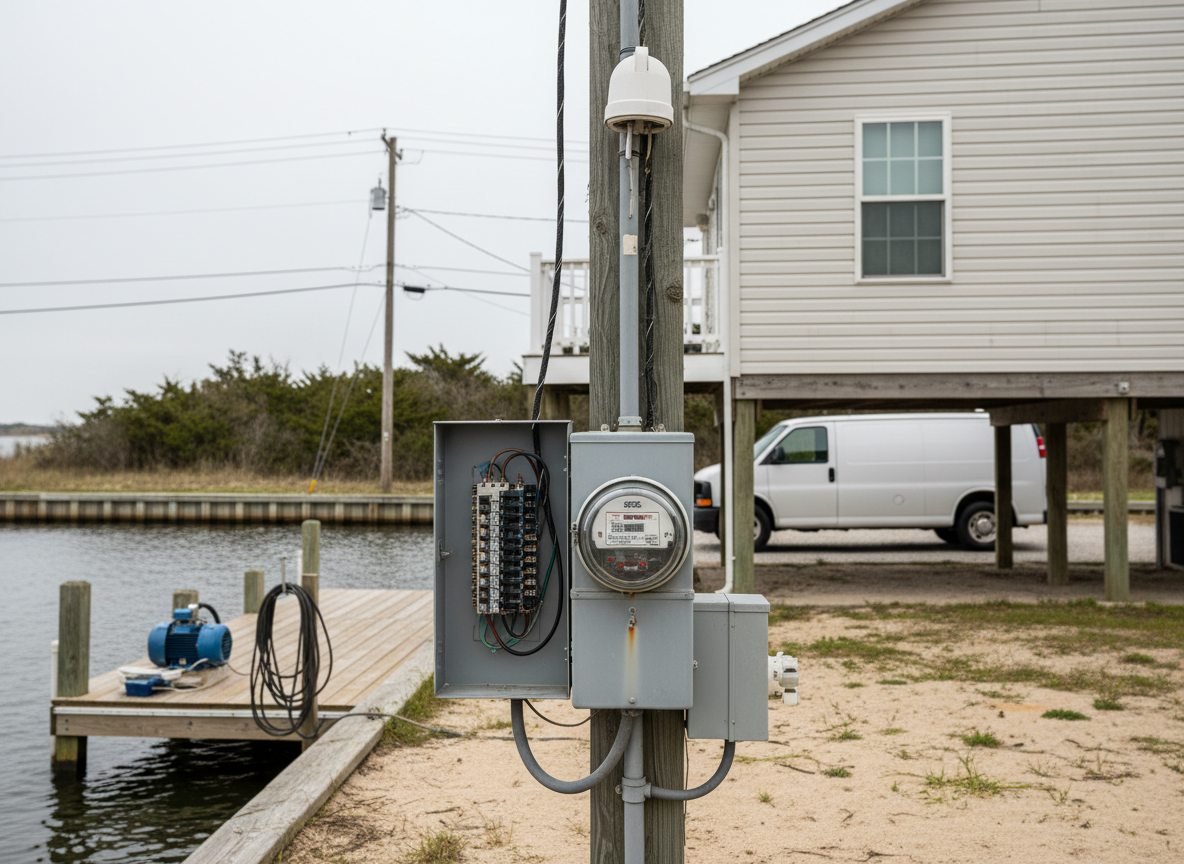
On a typical overhead service, JCP&L owns the service drop, the three wires running from the pole to your house, and the meter that plugs into the socket. You own the weatherhead, the service mast or conduit, the meter base it plugs into, the service entrance conductors and the panel. The dividing line is the splice at the weatherhead.
Where the Line Actually Falls
That splice point has a name worth knowing: the service point. It is the place where the utility's wiring ends and the customer's premises wiring begins. On an overhead service in Ocean County, the service point is almost always at the connectors just below the weatherhead, where JCP&L's aluminum triplex is spliced to the three conductors coming out of your mast.
Everything on the pole side of that splice is the utility's problem. Everything on the house side is yours, including the parts you might assume are theirs because they are outdoors and covered in weather. The meter base bolted to your siding is yours. The meter glass inside it is theirs, which is why it carries their seal and why you should never break that seal to pull it.
Underground services follow the same logic with different hardware. The lateral from the transformer or pedestal to your meter base is typically the utility's, the meter base and everything downstream is yours. The trench, the conduit and any repairs to a damaged riser are usually the homeowner's cost even when the conductors inside belong to JCP&L.
Why the Split Exists at All
Utilities standardize on the point where they can safely de-energize and reconnect without entering the building. A lineman can work the drop from a bucket truck, cut it clear at the splice and leave the house dead without ever touching customer equipment. That is the whole engineering logic behind the boundary.
It also explains the shape of the hardware. The weatherhead is a bell-shaped fitting with an insulated bushing whose only job is to let conductors exit a mast pointing downward, so rain runs off the wire and drips before it reaches the opening. The conductors are looped below the entry point on purpose. That loop is the drip loop, and it is the difference between water running away from your service and water running into your mast, down the inside of the pipe, and into the top of the meter base.
The other reason the split matters is mechanical. A service drop is a span of heavy wire under tension, and it pulls sideways and down on whatever it is attached to. On a two story home in Toms River, that pull is anchored to a service mast, usually 2 inch rigid conduit, braced through the roof. Wind loading during a nor'easter, ice loading in February, or a limb dropping across the span all transfer force straight into that mast and into the roof framing around it. When a mast leans, the utility's wire is often fine and the customer's pipe is what failed.
How to Tell What Failed From the Ground
Start with a visual from the driveway, not a ladder. Field diagnosis on a service problem is mostly geometry.
- Mast leaning toward the pole. The roof flashing has failed, the mast bracing pulled loose, or the framing behind it rotted. Customer side.
- Drip loops missing or the conductors pulling up into the weatherhead. The drop has stretched or the mast shifted. Water is now entering the mast.
- Insulation cracked and grey on the utility triplex. Age and UV on the utility's wire. Call JCP&L.
- Green or white crust at the splice connectors. Corroded aluminum splices, sitting right on the boundary. The utility handles the splice, but the corrosion often extends into your conductors.
- Burn marks or melted plastic on the meter base, or a warm meter cover. Customer side, and this one does not wait.
- Rust streaks running down the siding from the meter base. The enclosure is failing from the inside.
Two things fool people regularly. The first is half power, where some circuits work and others are dead or dim, lights flicker when the dryer runs, and electronics behave strangely. Homeowners call this a panel problem. Very often it is a lost neutral, and a lost neutral on an overhead service is more likely to be at the utility splice or in the meter base than in the panel. Checking voltage from each leg to neutral at the main will show one leg high and the other low, and that pattern points outside the house.
The second misdiagnosis is blaming the drop for a mast that is being pulled apart by tree growth. In older Toms River neighborhoods with mature oaks, a limb resting on the drop puts steady load on the mast for years before anything visibly breaks.
What to Do, and When It Becomes a Safety Problem
Call JCP&L first for anything in the span or at the splice, including a drop lying in the yard. Do not go near a downed conductor, and do not assume it is dead because the house is dark.
For customer side work, a service mast or meter base replacement is permitted work under the New Jersey Uniform Construction Code. The sequence is worth understanding because it drives scheduling. The Toms River Township Building Department issues the electrical permit, the electrician coordinates a disconnect with the utility, the work is done, an inspection is performed, and only then does the utility reconnect and reseal the meter. That coordination, not the labor, is usually what stretches a one day job across two or three.
It becomes urgent when the meter base is burned, arcing, or loose on the wall, when the mast has pulled the roof open, or when you have the lost neutral symptoms described above. A floating neutral can put well over 120 volts on part of the house and it destroys appliances quietly before it does anything dramatic. Anything involving a conductor you can reach, or a service that is visibly separating from the building, is a same day call.
One more local wrinkle: on raised homes near the water, the mast run is longer and the meter often sits higher than usual, which means more leverage on the bracing and more attention needed at the roof penetration. If you are unsure which side of the line your problem sits on, Electrician Toms River NJ can look at it and tell you who to call.
Frequently Asked Questions
Who pays if the weatherhead is damaged in a storm? The homeowner pays. The weatherhead, the mast and the conductors inside it are customer owned equipment, so storm damage there is your repair and often a homeowner insurance claim. JCP&L covers the drop from the pole to the splice. If both were damaged in the same event, the utility disconnects and reconnects around your electrician's repair at no charge for that coordination.
Can I replace a meter base myself? No. The meter socket connects directly to unfused utility conductors that are energized even with your main breaker off, and the meter carries a utility seal you are not permitted to break. The work requires a permit through the Toms River Township Building Department, a licensed electrical contractor, a scheduled utility disconnect and an inspection before the meter is reset.
How do I know if my mast is too short? Height is judged by the clearance the drop maintains over the ground, not the mast itself. Conductors generally need 10 feet above a walking surface, 12 feet over a driveway and more over anything a vehicle uses. If the drop sags low enough to reach from a ladder or a truck bed, the mast needs to be raised or a taller one installed.
Damaged customer side equipment is handled as service mast and meter base replacement.