2026-08-31 · Nick Petrucci
Federal Pacific Stab-Lok and Zinsco Panels in Ocean County Homes and How to Identify One
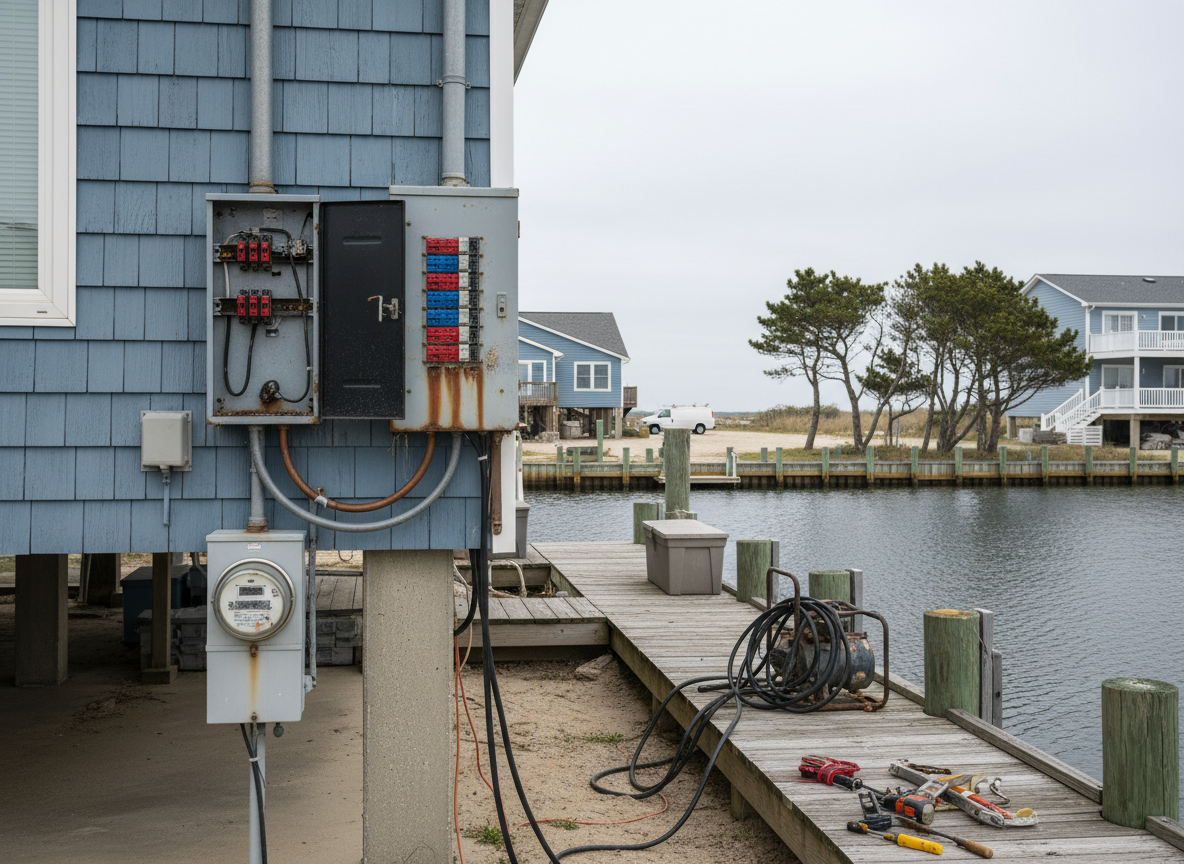
A Federal Pacific Stab-Lok panel is identified by the FPE or Federal Pacific label and breakers with a distinctive thin red stripe on the toggle. A Zinsco panel carries a Zinsco, Sylvania Zinsco or GTE Sylvania label and uses colorful breaker handles with an aluminum bus. Both designs have known failure modes in which the breaker fails to trip on an overload or a short.
What Went Wrong in Each Design
The two panels fail differently, and it is worth being precise rather than lumping them together.
In the Stab-Lok design, the problem is the breaker's internal calibration and its grip on the busbar. The breaker attaches to the bus by a spring clip, and the mechanism has a documented tendency to jam. Independent testing over the years found a meaningful share of these breakers would not trip within their rated time under overload conditions, and some would not trip at all. A breaker that holds its handle in the on position while the circuit is overloaded leaves the wire to act as the fuse. There is also a known issue with two pole breakers failing to trip and with the panel bus energizing a breaker that appears to be off.
Zinsco failure is more physical. The panel uses an aluminum bus, and the breaker clamps onto a bus finger rather than plugging onto a stab. Aluminum oxidizes, the joint heats, and heat softens the connection further, so the breaker can literally fuse itself to the bus. Once welded on, it cannot trip because the contacts cannot separate. The visible evidence is charring on the bus fingers and breakers that resist being pulled off. In humid coastal air, and in Ocean County that is most of the year, the aluminum bus oxidation runs faster than it would in a dry climate.
Both panels also suffer from a supply problem. Genuine replacement breakers are hard to source, and the aftermarket parts sold for them are of uncertain provenance. That matters because the correct fix for a bad breaker is normally to install a new one, and here that option is not dependable.
How to Identify One Without Guessing
You can do most of this from the outside of the panel with the cover on.
- Read the label. Look on the inside of the door or on the dead front for Federal Pacific Electric, FPE, Stab-Lok, Zinsco, Sylvania Zinsco, or GTE Sylvania. The word Stab-Lok is often molded into the plastic.
- Look at the breaker handles. Stab-Lok toggles are usually black with a narrow red stripe that shows when the breaker is on. Zinsco handles come in assorted colors, commonly with a slim rectangular profile, and the panel interior often shows a distinctive slotted aluminum bus.
- Check the panel age against the house. Homes built roughly 1950 through the early 1980s are the window. Holiday City and Silver Ridge Park ranches sit squarely in it, typically with 100 amp service and an original load center that was never touched.
- Look for heat. Browned or blackened bus fingers, a scorched breaker base, melted plastic around a stab, or a smell of hot plastic in the panel.
- Feel the breakers. A Zinsco breaker that will not come off with reasonable effort may be fused to the bus. Do not force it.
Beware of lookalikes. Not every panel with a red marking is FPE, and some later panels carry a Sylvania name without being Zinsco product. American brands from the same era with similar cabinets get misidentified constantly, and so do relabeled panels. The label on the dead front, not the cabinet, is what to trust.
Two common misdiagnoses run the other direction. First, a homeowner concludes the panel is fine because breakers have tripped before. Partial function is not evidence of reliability, because the failure is intermittent and depends on which breaker, and on how hot and how corroded that particular stab is. Second, a home inspector notes the panel and the homeowner replaces only the breakers. That solves nothing in a Zinsco, where the bus itself is the failing part, and it is unreliable in a Stab-Lok for the same reason plus the parts sourcing problem.
What to Do and When It Is Urgent
The remedy for both is replacement of the load center, not repair. That means a new panel with a new main breaker, new bus, new breakers, and reconnection of every branch circuit to the new enclosure, along with bringing the grounding electrode conductor and bonding up to current requirements.
What makes the job harder on site, and what drives the real cost, is rarely the panel itself:
- Short conductors. Original circuits were cut just long enough. A new panel with different knockout and bus geometry means splicing and extending in a junction box or gutter, which takes time.
- Aluminum branch wiring. Common in the same era of ranch homes, and every one of those terminations needs listed connectors and correct treatment.
- Grounding. Many original installs have a single ground rod or a water pipe connection that no longer qualifies. New rods usually get driven.
- Elevation. In flood zones, replacing a panel is the event that triggers relocating it above the design flood elevation.
- Modern requirements. A new panel means AFCI and GFCI protection on circuits that require it, which the old panel had none of.
All of this is permitted and inspected work under the New Jersey Uniform Construction Code. The Toms River Township Building Department issues the permit and schedules the inspection, and the power has to be dropped and reconnected by the utility, so plan on the home being without power for a good part of a day.
It becomes an emergency when there is evidence of heat: scorching in the panel, a burning smell, a breaker that is hot to the touch, a breaker that will not reset, flickering that tracks with load, or a breaker that did not trip on a circuit that clearly faulted. Any of those means the protection you are relying on is already compromised. If you are not sure what you have, Electrician Toms River NJ can open it, identify it and tell you honestly whether it needs to go now or can be scheduled.
Frequently Asked Questions
Does a Federal Pacific panel have to be replaced immediately? Not always immediately, but it should be planned rather than ignored. The failure mode is a breaker that does not trip when it should, which gives no warning and no symptom until there is a fault. If the panel shows scorching, heat, a breaker that will not reset, or a circuit that faulted without tripping, it moves from planned work to urgent work.
Can I just swap the breakers instead of the whole panel? No, and this is the most common wasted expense on these panels. In a Zinsco the aluminum bus is the failing component, so a new breaker clamps onto the same degraded connection. In a Stab-Lok, replacement breakers of dependable origin are difficult to source. Replacing the load center addresses the bus, the breakers and the grounding together.
Will a Stab-Lok or Zinsco panel affect a home sale or insurance? Frequently, yes. Home inspectors flag both panel types as a matter of course, and some insurers ask about them or decline to write a policy until the panel is replaced. In practice the panel often surfaces during a sale in Holiday City or Silver Ridge Park and becomes a negotiating item, which is a reason to address it before listing.
The work itself is covered under replacing a Federal Pacific or Zinsco load center.