2026-08-31 · Nick Petrucci
Salt Air Corrosion: Why Outdoor Electrical Equipment Fails Faster Near the Bay
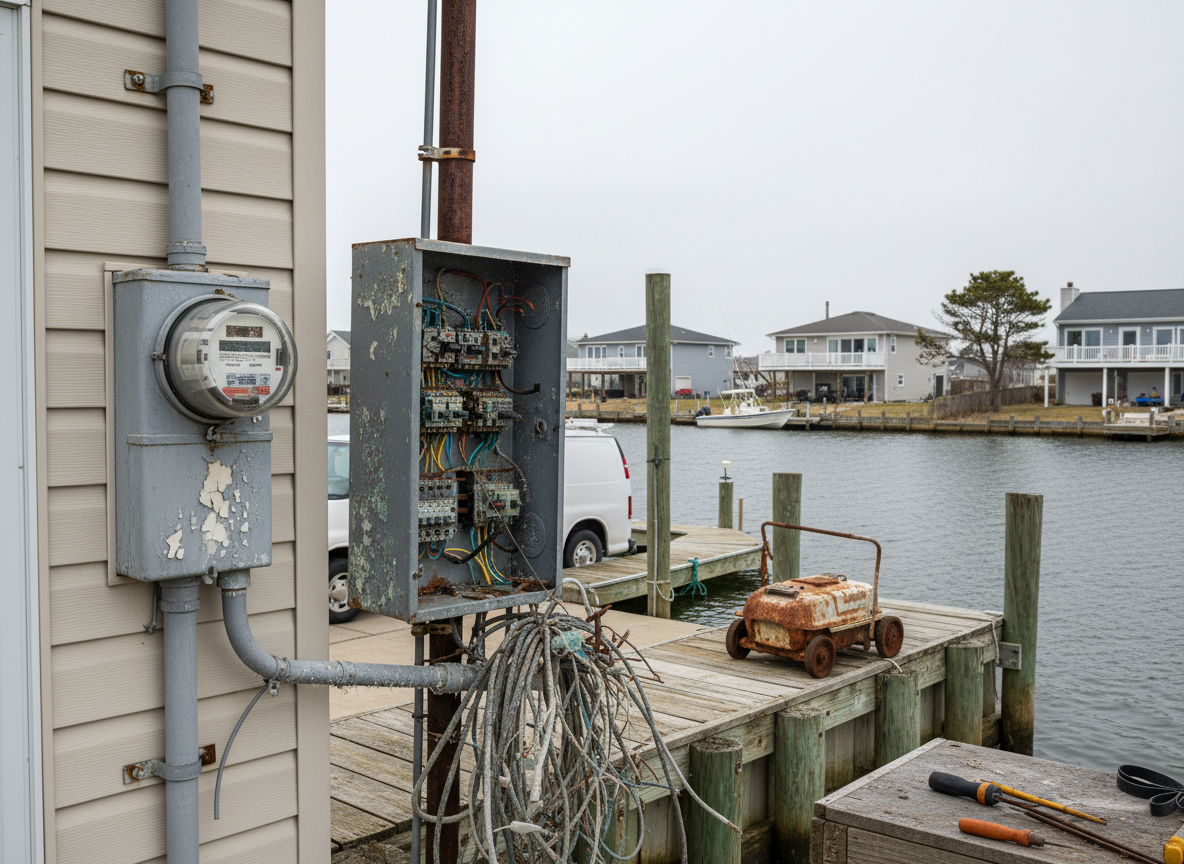
Outdoor electrical equipment near the bay fails faster because airborne salt deposits on metal surfaces, absorbs moisture from humid air, and forms a conductive electrolyte film that keeps working even when it has not rained. That film accelerates galvanic corrosion at every joint between dissimilar metals, which in electrical work means nearly every termination.
The Mechanism: Salt, Moisture and Dissimilar Metals
Sea spray and wind carry chloride particles inland. They settle on a meter base, a disconnect, a mast, a light fixture and a receptacle cover. Salt is hygroscopic, meaning it pulls water vapor out of the air, so at the humidity levels normal for a Toms River summer those deposits stay wet without any rainfall. Now you have a thin layer of salt water sitting permanently on steel and aluminum.
That electrolyte enables galvanic corrosion. When two different metals are in electrical contact in the presence of an electrolyte, the less noble metal corrodes preferentially. Electrical hardware is full of these pairs: aluminum conductors under steel screws, copper conductors in aluminum lugs, zinc plated hardware on galvanized enclosures, stainless straps against aluminum conduit. Inland, the reaction is slow because the electrolyte is only present when it rains. On a lagoon in Silverton or a bayfront lot, it never really stops.
Aluminum adds a second wrinkle. Aluminum forms a hard oxide layer that protects it, but chloride ions attack that layer locally, producing pitting corrosion: deep, narrow craters rather than uniform surface loss. A conductor can look acceptable and have lost significant cross section at a pit. Less metal at that point means higher resistance, higher resistance means heat, and heat at a termination is how connections cook.
There is a mechanical side too. Corrosion products occupy more volume than the metal they came from, so an oxidizing joint physically expands and pushes itself apart. Add daily thermal cycling from load and sun and you get a connection that loosens itself over a few seasons with nobody touching it.
Where It Shows Up First
Failures follow a predictable order, and knowing the order makes inspection fast.
- Meter base bottoms. Water sits at the low corner, salt concentrates as it evaporates, and rust starts inside and works out. Rust streaks on the siding under the meter are a late symptom, not an early one.
- Service mast and weatherhead. The bell, the bushing and the connectors at the splice.
- Outdoor disconnects and AC disconnects. The cover gasket dries out, the enclosure fills with damp air, and the switch contacts pit.
- GFCI receptacles on decks and docks. Salt bridges across the face, leakage rises, and the device begins tripping on humid days before it fails outright.
- Dock lighting, boat lift circuits and shore power. These live closest to the water and see direct spray.
- Ground rod connections. The acorn clamp at the ground rod is buried in wet, salty soil and is routinely the most corroded part of a whole system.
- Panel interiors on exterior walls. Air moves through conduit, and salty air ends up inside the enclosure whether or not water ever enters it.
Diagnosing It Properly
The first thing an electrician does on a coastal service call is open the outdoor equipment and look at terminations under load, not just cold. A thermal check on a working circuit tells you more than a visual inspection, because a corroded termination that looks passable will run noticeably hotter than its neighbors carrying the same current.
Next is the physical check: back out a screw on a lug and feel whether the conductor is bright or crumbly, look for white powder around aluminum, look for the characteristic green on copper, and check whether corrosion products have bridged between a terminal and the enclosure. Any bridging is a fault path.
Grounding gets tested rather than eyeballed. A corroded ground rod clamp can look fine and be electrically useless.
Two misdiagnoses come up over and over. The first is the nuisance tripping GFCI. Homeowners replace the same dock or deck receptacle repeatedly because it trips on damp days. The device is usually working correctly and reporting real leakage current through salt contaminated wiring or a corroded box. Replacing the receptacle without correcting the enclosure and the terminations just resets the clock.
The second is blaming the utility for flickering. Flicker on a bayfront home is frequently a corroded neutral termination in the meter base or the main lugs, not a supply problem. Voltage that sags when a big load starts and recovers slowly points at a resistive connection, and on the water the resistive connection is almost always corrosion.
What makes the work harder on site is honest to admit: hardware seizes. Bolts shear, enclosure screws round out, conduit fittings will not break loose, and a straightforward disconnect replacement turns into cutting and rebuilding the run. Anyone quoting coastal exterior work as if it were inland work is guessing.
What to Do About It
Material selection does most of the work.
- Use corrosion resistant enclosures. NEMA 3R is the minimum for rain tight outdoor use, and near the water non metallic or stainless enclosures outlast painted steel by a wide margin.
- Treat every aluminum termination with an oxide inhibitor and torque it to specification with a torque screwdriver. Guessing at torque is a common cause of hot terminations.
- Keep dissimilar metals apart. Use listed bimetallic connectors where copper meets aluminum, and stainless hardware where hardware is exposed.
- Use in-use weatherproof covers, gasketed device boxes and corrosion rated fittings on anything on a deck or dock.
- Seal conduit entries so salty air is not being pumped into panels by daily temperature swings.
- Inspect on a schedule. Annually on the bay, every two or three years further inland.
It becomes a safety issue when heat enters the picture. Discoloration at a lug, a warm cover, a burnt smell, breakers that trip under normal load, or lights dimming when a motor starts all indicate a high resistance connection carrying current. That condition does not stabilize. It gets hotter as it corrodes further, and it is a common ignition source at meter bases and main lugs. Corrosion that has reached bare conductor inside a service enclosure is a call now, not a spring project.
If you are on a lagoon or the bayfront and your outdoor equipment has never been opened and inspected, Electrician Toms River NJ can go through it and tell you what is still sound.
Frequently Asked Questions
How far inland does salt air damage reach? Salt aerosol effects are strongest within roughly the first half mile of open water and taper off from there, but the barrier island and the lagoon and bayfront neighborhoods on the mainland side are all firmly in the affected band. Wind direction matters as much as raw distance: an exposed western wall facing the bay corrodes faster than a sheltered side of the same house.
Will a stainless steel enclosure solve the problem? It helps considerably but does not eliminate it. Stainless resists surface rust far better than painted steel, so the enclosure lasts, but the terminations inside are still aluminum and copper under steel screws and they still corrode. Enclosure material buys you the box. Proper connectors, oxide inhibitor, correct torque and sealed entries buy you the connections.
Why does my outdoor GFCI trip only when it is humid? Because leakage current rises with moisture. Salt residue on the device face, inside the box or on the wiring becomes conductive as it absorbs humidity, letting a few milliamps escape to ground, which is exactly what the GFCI is built to detect. The device is doing its job. The correction is cleaning or replacing the contaminated wiring and box and sealing the enclosure.
Waterside circuits are covered under dock lighting, boat lift and shore power wiring.