2026-08-31 · Nick Petrucci
Why Breakers Trip on the First Humid 90 Degree Weekend of the Summer
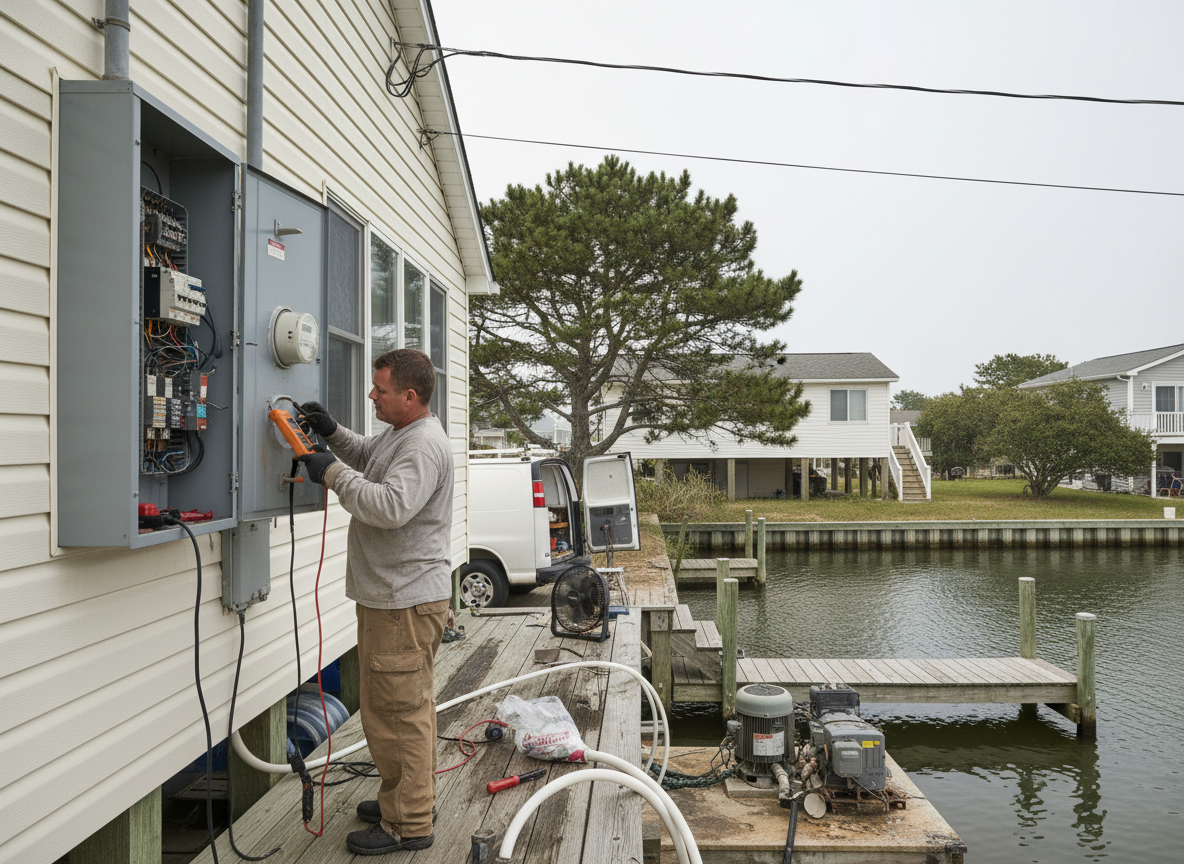
Breakers trip on the first hot humid weekend because three things change at once: total load rises sharply as air conditioning runs continuously, ambient temperature inside the panel rises, and humidity lowers the resistance of every marginal insulation path in the house. A breaker that held all spring at 60 percent load and 70 degrees is now at 90 percent load and 100 degrees inside the enclosure.
The Mechanism: Heat Is the Whole Story
A standard thermal magnetic breaker has two trip mechanisms. The magnetic element responds instantly to a large fault current, like a short circuit. The thermal element is a bimetallic strip that bends as current heats it, and trips after a delay that gets shorter as current rises. It lets a motor draw heavy starting current for a second without tripping, while still opening on a sustained overload.
The thermal element does not know the difference between heat from current flowing through it and heat from the air around it. Breaker trip curves are rated at a reference ambient temperature. Put the same breaker in a panel in a hot garage, an unconditioned attic space or a sunlit exterior enclosure in August, and it trips at a lower current than it would in February. This is normal behavior, not a defect, and it is the single largest reason summer trips cluster.
Add the load side. A central air condenser is often the largest single load in the house. When it starts, the compressor draws locked rotor current, typically five to seven times its running current, for a fraction of a second. A compressor with worn bearings, low refrigerant charge, a failing start capacitor or a dirty condenser coil draws locked rotor current for longer, or draws higher running current continuously because the head pressure is up. Now the breaker sees genuine sustained overload, and it does exactly what it is supposed to do.
Telling the Causes Apart
There are six common causes and they behave differently.
- Genuine overload. The breaker trips after minutes to tens of minutes of heavy use, resets normally, and trips again at the same point. Usually a circuit carrying too much: a window unit plus a refrigerator plus a television on one 15 amp bedroom circuit. The breaker is right.
- A heat aged breaker. Trips at loads it used to carry, often at progressively lower currents, and may feel warmer than its neighbors. Thermal elements drift after years of cycling and heat. Common on 1960s to 1980s panels across Holiday City and Silver Ridge Park.
- A loose or double tapped connection. The classic tell is heat without a corresponding trip, or tripping that correlates with load rather than with a specific appliance. Loose terminations create resistance, resistance creates heat under load, and the heat both damages the connection further and warms the breaker's thermal element. A double tap, meaning two conductors under a terminal listed for one, is the version we find most. It works fine at low load and heats badly in July.
- Locked rotor current on a failing condenser. Trips at the moment the compressor starts, or a few seconds after, often only on the hottest afternoons. Lights across the house may dim noticeably at the same instant. This is a mechanical or refrigerant problem showing up as an electrical symptom.
- Undersized branch circuits with window units. Window air conditioners on 15 amp circuits shared with other loads, run through extension cords. Very common on summer rentals, where occupancy triples and every bedroom gets a unit plugged into whatever outlet is nearest.
- GFCI and AFCI tripping in humid conditions.
Why GFCI and AFCI Devices Trip When It Gets Humid
A GFCI compares current leaving on the hot with current returning on the neutral and opens when the difference exceeds about 5 milliamps. Humidity creates leakage paths: moisture in an outdoor receptacle box, condensation inside a garage or crawlspace device, a damp exterior fixture, water in a conduit that fills during a storm. Each path leaks a small amount of current to ground.
That is usually a real fault, not a nuisance. The most common misdiagnosis is treating a summer GFCI trip as a bad device and replacing it. On bayfront and lagoon properties, salt in the moisture makes it conduct better, and corroded receptacle contacts inside a weatherproof cover leak long before anything looks wrong from outside.
AFCI breakers look for the current signature of an arcing fault. Damaged insulation, a backstab connection loosening in a receptacle, a nail through cable, or a deteriorating cord all produce arcing that gets worse when conductors expand with heat and when humidity lowers the breakdown resistance. AFCIs also react to some motor loads and to certain electronic power supplies, so genuine false trips exist, but a device that only trips in July is more often finding something real.
What an Electrician Checks First
We start with a thermal check of the panel under load, ideally on a hot afternoon with the air conditioning running. A breaker or termination running noticeably hotter than its neighbors points straight at a loose connection or a failing breaker. Then we check every terminal by hand for tightness and look for double taps, backed out lugs and discolored conductor insulation, which is the visual signature of a connection that has been heating for years.
A clamp meter on the suspect circuit under real load answers the overload question in one reading. A clamp on the condenser conductors at startup shows whether locked rotor current is normal or extended.
On the branch side we map what is actually on the circuit, because panel labels are frequently wrong and circuits in older Toms River housing were extended over decades. Aluminum branch wiring in 1960s and 1970s construction adds another layer: aluminum expands and contracts more than copper, so connections that were adequate in spring loosen under summer cycling. Those get addressed with listed connectors such as AlumiConn, not by retightening and hoping.
The three misdiagnoses we correct most: replacing a breaker that was correctly reporting an overload, replacing a GFCI that was correctly reporting moisture intrusion, and calling an HVAC problem an electrical problem or the reverse.
When It Becomes a Safety Issue
Call for service now if a breaker or the panel cover is hot to the touch, if you see or smell scorching, if a breaker will not reset or resets and immediately trips, if the panel is a Federal Pacific Stab-Lok or Zinsco, or if lights across the house dim hard every time the condenser starts. Repeated resetting of a breaker that keeps tripping is the specific behavior that turns a manageable problem into a fire, because each reset pushes current back through a connection that is already overheating.
Also treat a breaker that stops tripping as a problem. A heat aged breaker that no longer trips is worse than one that trips early, because the overload protection for that circuit is gone and nothing tells you.
If your breakers are tripping on the hot days and holding the rest of the year, that pattern is diagnosable, and we are happy to take a look.
Frequently Asked Questions
Is it bad to keep resetting a breaker that trips? Yes. Resetting repeatedly pushes current back through whatever is overheating, whether that is an overloaded conductor, a loose termination or a failing appliance. The breaker is doing its job by opening. Reset it once. If it trips again, shut off or unplug what is on the circuit and find out why before resetting a third time.
Why does my GFCI only trip on humid days? Moisture is creating a leakage path to ground somewhere on the circuit, and humid air plus salt residue lowers the resistance of that path enough to exceed the 5 milliamp threshold. Common sources are outdoor receptacles, garage and crawlspace devices, damp exterior fixtures and water sitting in conduit. It is finding a real fault, so the device should be traced, not replaced.
Can a breaker go bad from age? Yes. The bimetallic thermal element drifts over decades of load cycling and heat, so an old breaker can trip below its rating or, worse, fail to trip at all. Breakers in panels from the 1960s through the 1980s are frequently at that point. A voltage drop measurement across the breaker under load, along with a thermal check, identifies the ones that need replacing.
Related reading: finding loose connections and heat aged breakers.