2026-08-31 · Nick Petrucci
Why 100 Amp Service Cannot Keep Up With Central Air, an EV Charger and a Modern Kitchen
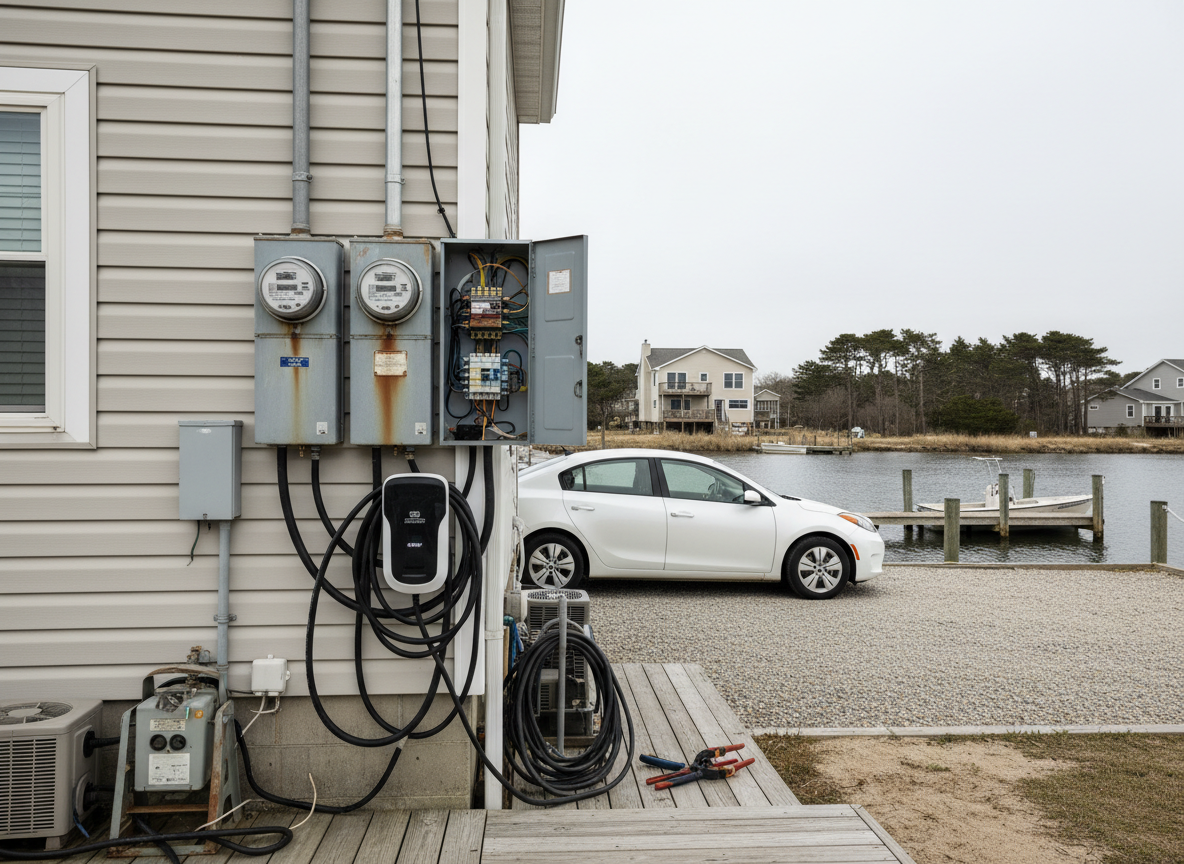
A 100 amp service delivers about 24,000 volt amps at 240 volts. A 1,600 square foot house with an electric range, an electric dryer, a heat pump water heater and central air already lands within a few amps of that ceiling before anything else is added. A Level 2 EV charger adds roughly 11,500 volt amps on its own. The arithmetic runs out, not the wire quality.
Where the 100 Amp Number Actually Comes From
Service size is not a guess. The NEC gives two methods for a dwelling load calculation, and New Jersey enforces them through the Uniform Construction Code electrical subcode. The optional method most electricians use for existing homes works like this: total up the general lighting and receptacle load at 3 volt amps per square foot, add the required small appliance and laundry circuits, add the nameplate rating of every fixed appliance, take the first 10,000 volt amps of that total at 100 percent and everything above it at 40 percent, then add the larger of the heating or air conditioning load at 100 percent on top.
That last step matters. Heating and cooling are not added together, because they do not run at once. Everything else is discounted because a house never runs all of it simultaneously. The 40 percent factor is what lets a 100 amp service carry far more connected equipment than 24,000 volt amps of nameplate.
Running the Numbers on a Real House
Take a 1,600 square foot ranch, the kind built across Holiday City and Silver Ridge Park in the 1960s and 1970s, updated over the years.
- General lighting and receptacles: 1,600 x 3 = 4,800 VA
- Two small appliance circuits: 3,000 VA
- Laundry circuit: 1,500 VA
- Electric range, 12 kW nameplate: 12,000 VA
- Electric dryer: 5,000 VA
- Dishwasher: 1,200 VA
- Disposal: 900 VA
- Heat pump water heater with resistance backup: 4,500 VA
That subtotal is 32,900 VA. First 10,000 at 100 percent gives 10,000. The remaining 22,900 at 40 percent gives 9,160. Running total: 19,160 VA.
Now add cooling. A 3 ton central air condenser plus the air handler blower runs about 5,000 VA, added at 100 percent. Total: 24,160 VA, which is 100.7 amps at 240 volts.
That house is already past a 100 amp service, with no EV charger and no additions. Add a 48 amp Level 2 EV charger on a 60 amp circuit, counted at 100 percent because it is a continuous load, and you add 11,520 VA. The calculated load becomes 35,680 VA, or 148 amps. That is a 200 amp service, not a 100 amp service with a spare slot.
Change the assumptions and the picture changes. Swap the electric range for gas, drop the electric dryer to gas, and the same house with an EV charger calculates near 110 amps. Add energy management on the EV charger so it sheds load when the rest of the house draws heavily, and it can sometimes be counted at a reduced value. The calculation is the whole conversation, not the panel label.
The Three Different Bottlenecks
Homeowners say "I need a bigger panel." Often they do. But there are three separate limits and they fail differently.
The panel, or load center, has a busbar rating and a physical slot count. A 100 amp panel with 20 spaces that is already full of tandem breakers has run out of space long before it runs out of ampacity. Replacing the panel alone solves space and gives you modern AFCI and GFCI breakers, but it does not raise the service size by itself.
The service entrance conductors run from the meter to the main breaker, and from the weatherhead down. Their ampacity is fixed by size and type. Copper 2 AWG or aluminum 1/0 is typical 100 amp material. Going to 200 amps means new conductors, usually 4/0 aluminum, and frequently a new meter base, a new service mast and a new weatherhead, because the existing ones were sized and drilled for smaller wire.
The utility drop is JCP&L's responsibility. The service drop from the pole, the connection at the weatherhead and the transformer feeding the street all belong to the utility. On most Toms River residential streets this is not the constraint, but on long runs, older overhead sections and a few lagoon streets where several homes have upgraded at once, the transformer or drop becomes the pacing item and the utility schedule sets the date, not us.
What an Electrician Checks First
Before quoting anything, we open the panel and read the meter. The first questions are practical.
- What is actually in the panel now? Double taps, tandem breakers where the panel is not listed for them, and a neutral bar landing grounds and neutrals together on a subpanel all tell us the history.
- What is the real load, not the calculated one? A recording ammeter or a clamp meter on the service conductors during a hot afternoon shows peak draw. Calculated load and measured load are different numbers and both matter.
- What is the panel brand? Federal Pacific Stab-Lok and Zinsco panels are common in this area and they are a replacement conversation regardless of amperage, because breakers in them do not reliably trip.
- Where does the equipment sit? On homes rebuilt after Superstorm Sandy, the panel and meter were relocated above base flood elevation. Anything below that line is a rework, and flood zone placement drives the whole layout.
- Working clearance. A panel in a closet or behind a water heater fails inspection. Solving that is sometimes the largest part of the job.
The most common misdiagnosis is a homeowner concluding the service is too small because breakers trip. Nuisance tripping is usually a branch circuit problem, a failing breaker or a specific appliance, not a service capacity problem. A truly overloaded service trips the main breaker or shows voltage sag and dimming under load, not a single bedroom circuit going out.
When It Becomes a Safety Issue
Persistent main breaker trips, a warm or discolored meter base, lights dimming noticeably every time the condenser starts, or a burning smell at the panel are reasons to stop adding load and get it looked at now. Heat at the service entrance is not something to monitor.
Practically, the trigger point for most owners is an EV. A 100 amp house can often add a Level 2 charger at a reduced amperage setting or with load management, and that is worth calculating before assuming a service upgrade. But if the range, the dryer and the water heater are all electric and there is central air, the calculation usually says 200 amps, and doing it once is cheaper than doing it twice. Service upgrades in Toms River require a permit, an inspection and coordination with JCP&L for the disconnect and reconnect, so the schedule is longer than the labor suggests.
If you want the actual load calculation run on your house before you commit to anything, that is a short visit and a clear number.
Frequently Asked Questions
Can I add an EV charger to a 100 amp service? Sometimes, yes. It depends on whether your range, dryer, water heater and heat are gas or electric. A gas heated house with a gas range often has room for a Level 2 charger at 32 or 40 amps. An all electric house with central air usually does not, unless the charger uses load management to shed while other equipment runs. The load calculation decides it.
Will replacing my panel give me more amps? Not by itself. The panel is one of three limits. If the service entrance conductors, meter base and mast are still sized for 100 amps, a new 200 amp rated panel is still fed by 100 amp wire and protected by a 100 amp main. Raising the service means new conductors, usually new meter equipment, a permit, an inspection and a JCP&L reconnect.
How do I know if my service is overloaded right now? Watch for main breaker trips, noticeable dimming when the air conditioner compressor starts, or a meter base that is warm to the touch. Individual branch circuit breakers tripping usually points to that circuit, not the service. A clamp meter reading on the service conductors during a hot afternoon gives an actual peak number rather than a guess.
Related reading: raising a 100 amp service to 200 amps.