2026-08-31 · Nick Petrucci
Whole Home Surge Protection and Why Coastal Grids Produce So Many Surge Claims
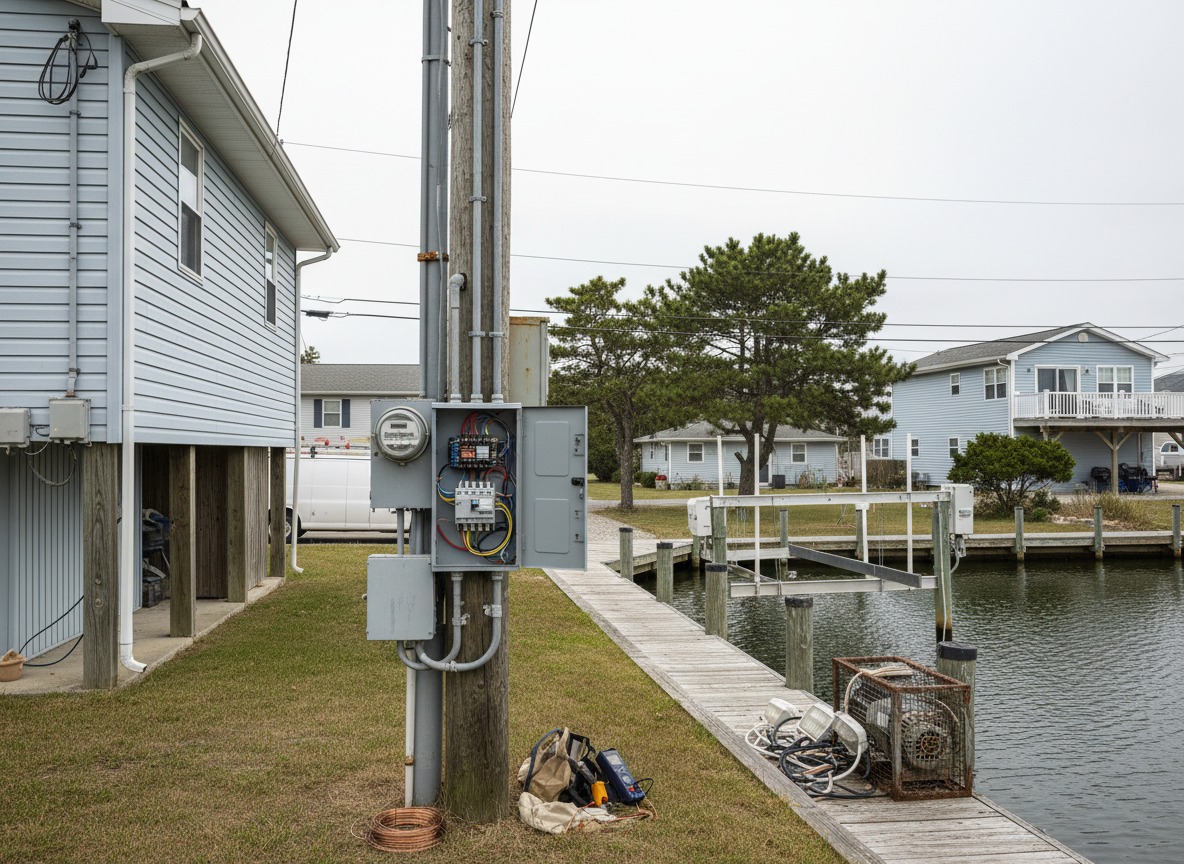
A whole home surge protective device installs at the service panel and clamps voltage spikes before they reach branch circuits. It does not stop a direct lightning strike. What it does is absorb the far more common events: utility switching, reclosing after a fault, motor loads cycling and nearby strikes coupling into overhead lines. Coastal grids produce more of those events than inland grids, which is why the damage shows up here more often.
The Mechanism: What a Surge Actually Is
Normal residential voltage sits near 120 volts to neutral. A surge is a spike above that, lasting microseconds. Electronics do not fail because 120 volts became 130. They fail because 120 volts became 1,200 volts for 40 microseconds, and the insulation and semiconductor junctions inside a power supply cannot take it.
The working part of an SPD is usually a metal oxide varistor, or MOV. At normal voltage it behaves like an insulator. Above its clamping threshold its resistance collapses and it shunts the excess energy to the neutral and grounding system, holding the voltage at the panel down to a level the equipment downstream can survive. That number is the voltage protection rating, and it is the specification that matters most. A device with a lower clamping value passes less energy through to your equipment.
MOVs wear. Every event they absorb degrades them slightly. This is the part homeowners miss: a surge protector is a consumable. After enough events it stops protecting, and unless it has a status indicator you will not know. That is why quality devices have an indicator light or an audible alarm, and why we check that light on every service call at a panel that has one.
Why the Coast Is Harder on Equipment
Several conditions stack up along the Ocean County shoreline.
Distribution here is largely overhead. Overhead conductors are exposed to wind, tree contact, salt contamination on insulators and animal contact, and each fault causes the utility protection to open and reclose. Every one of those reclosing operations is a voltage transient into every house on the circuit. A summer of nor'easter remnants and afternoon thunderstorms means many of them.
Salt is the second factor. Salt film on insulators and on outdoor equipment lowers the flashover voltage, which means faults happen at conditions that would not cause them inland. The same salt corrodes the parts of your own system that a surge device depends on: the grounding electrode conductor connection, the ground rod clamp, the neutral bar in the meter enclosure.
Third is load density in summer. The seasonal population increase in Toms River and along the barrier island puts heavy air conditioning load on circuits sized around a much smaller off season demand. Heavy inductive load switching on and off produces its own transients, and voltage on a loaded feeder swings more.
Fourth, and specific to this area, is what the Sandy rebuild left behind. Service equipment was relocated above base flood elevation on thousands of homes. Grounding electrode systems were re-established under time pressure, and we regularly find a ground rod clamp that was never tightened properly or a grounding electrode conductor connected to a piece of relocated equipment rather than run properly to the electrode. A surge device with a compromised path to earth cannot do its job, because it has nowhere to send the energy.
How to Tell Whether Surges Are the Problem
Surge damage rarely announces itself. What we see reported are unrelated sounding complaints that share a pattern.
- LED bulbs and fixtures failing early and repeatedly, especially cheap drivers, in multiple rooms
- HVAC control boards failing, sometimes twice in a few seasons
- Garage door opener logic boards, network equipment, cable modems and doorbell transformers going out during storm season
- Appliance control boards on ranges, dishwashers and washers failing while the mechanical parts are fine
- Multiple unrelated devices failing on the same night
One failed device is a failed device. Several across different circuits, clustered around storm activity, points at incoming transients.
What we check first is not the surge device. It is the grounding and bonding. We verify the grounding electrode conductor is intact and properly sized, that the ground rod connections are solid and not corroded, that the neutral and ground are bonded at the service and only at the service, and that any subpanel has separated neutrals and grounds. A surge protector installed on a system with a poor earth connection produces false confidence.
Then we look at the panel. Is there room next to the main breaker for a two pole device with short leads? Lead length is a real specification, not a preference. Every inch of conductor between the SPD and the busbar adds inductive voltage during a fast transient, and a device on 24 inches of loosely routed wire clamps meaningfully worse than the same device on 6 inches.
The most common misdiagnosis is blaming the utility for equipment failures that are actually caused by a loose neutral, either in the panel or at the service. A degraded neutral connection produces voltage swings that look exactly like surge damage: one leg of the panel reading high while the other reads low, lights brightening in one part of the house while dimming in another. That is a different and more urgent problem, and no surge device fixes it.
What To Install and When It Matters
Protection works in layers. A Type 1 device installs on the line side of the service disconnect, often at the meter. A Type 2 device installs on the load side, in or beside the panel, and is what most homes get. Either one handles the large incoming energy. Type 3 point of use protectors, the strips behind your television or computer, handle the residual and the transients generated inside the house. A panel device alone leaves sensitive electronics slightly exposed. Point of use strips alone leave the hardwired equipment, meaning the HVAC, the well pump, the appliances, completely unprotected.
Practical selection points: look at the voltage protection rating rather than the joule number alone, confirm the device has a status indicator, confirm it is listed for the panel it is going into, and confirm there is a dedicated breaker rather than a shared one.
It becomes a safety issue in a few specific situations. A surge device that has failed shorted can overheat, which is why it belongs on its own breaker. Any sign of heat, discoloration or a burning smell at the panel is a stop and call situation. Signs of an unstable neutral, meaning lights brightening and dimming across the house or measured voltage well off 120 on either leg, are urgent regardless of surge protection, because that condition damages equipment continuously and can overheat conductors.
Installation in New Jersey means a permit and an inspection through the Toms River Township Building Department when it involves work in the service equipment, and that is worth doing correctly. If you want the grounding checked before adding surge protection, that is the sensible order and we are glad to look.
Frequently Asked Questions
Does whole home surge protection stop lightning damage? No device stops a direct strike to your house or service. What a panel SPD handles is everything else: nearby strikes coupling into overhead lines, utility reclosing after a fault, switching transients and voltage spikes from large motor loads. Those events cause most of the equipment damage homeowners actually experience, and they happen far more often than direct strikes.
How long does a surge protector last? It depends entirely on how many events it absorbs, not on time alone. The MOVs inside degrade with each surge, so a device on a coastal overhead circuit with heavy storm activity wears faster than one inland. Check the status indicator periodically. When the light changes or goes out, the device has reached end of life and needs replacement.
Do I still need power strips if I have a panel device? Yes, for sensitive electronics. A panel device knocks down large incoming transients but some residual voltage still passes through, and transients generated inside the house by your own motor loads start downstream of the panel. Point of use protection on computers, televisions and network equipment catches that remainder. The two work together rather than replacing each other.
Related reading: checking grounding and service equipment before adding an SPD.