2026-08-31 · Nick Petrucci
What Storm Surge and Flooding Do to Wiring, Panels and Outlets Below the Water Line
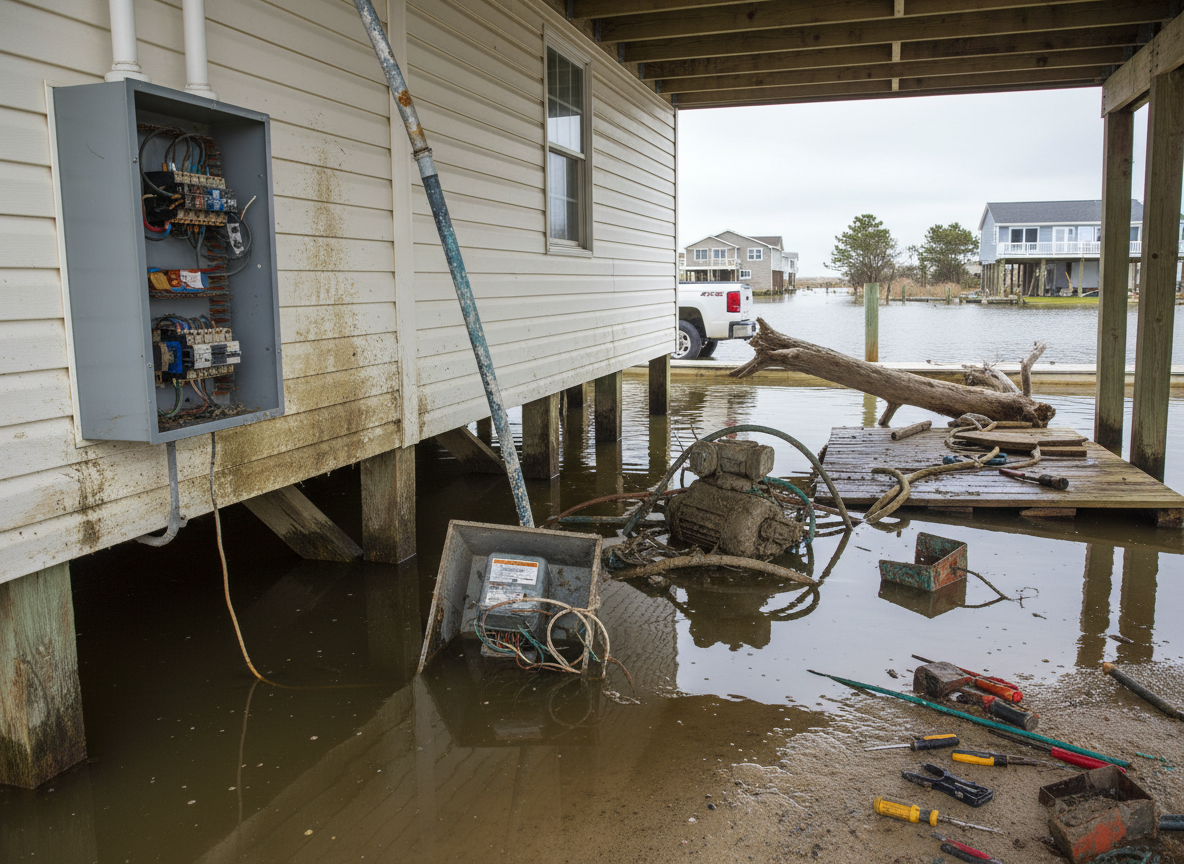
Storm surge does not simply wet electrical equipment. Salt water carries chloride into every enclosure, connection and cable end it reaches, and the residue keeps drawing moisture and corroding metal after the water is gone. Panels, breakers, devices and cable below the water line get replaced, because drying restores appearance, not function.
Why Salt Water Damage Is Permanent
Fresh water is bad. Salt water is a different category. Three things happen at once.
Chloride ions attack metal at contact surfaces where the plating is thinnest: breaker stabs, busbar contacts, screw terminals, receptacle contacts, the crimped ends inside a meter base. Corrosion there raises resistance, and resistance under load makes heat.
Salt residue is hygroscopic, meaning it pulls moisture out of humid air. A panel that flooded in October and looks dry in December still has salt on the insulating surfaces between energized parts, and on the next humid stretch that salt film becomes conductive again. This is why a panel can pass a casual look and then track and arc across the dead front months later.
Third, water wicks. Cable is not sealed. Water travels along the conductors inside NM cable by capillary action, well past the visible water line, sometimes several feet up a wall stud. The jacket looks dry outside while the conductors inside are wet and corroding. This is the single most underestimated part of flood damage, and it is why the replacement line is drawn above the observed high water mark, not at it.
Silt makes it worse. Surge water in the lagoon and bayfront neighborhoods carries sand, mud, fuel and sewage, and that sediment settles inside enclosures where it holds moisture indefinitely.
What Gets Replaced and What Can Stay
The standard response after submersion is not subtle, and manufacturers say the same thing in their own documentation: submerged electrical equipment is replaced, not reconditioned.
- Circuit breakers. Always replaced. A breaker is a mechanical device with a thermal element and a spring loaded trip mechanism inside a sealed looking but not sealed case. Once water is in it, the trip characteristics are unknown, and a breaker that closes and carries load may not trip on a fault.
- The panel enclosure, busbar and neutral bar. Replaced if it was submerged. Corrosion at the stabs and bar is not repairable.
- The meter base and service equipment. Replaced if below the line, coordinated with JCP&L for a disconnect and reconnect.
- Receptacles, switches, GFCI devices and cover plates. Replaced. These are inexpensive and their contacts corrode readily.
- Wiring devices' cable. Any NM cable or romex that was submerged gets replaced, cut back above the wick line.
- Conduit systems. Wire pulled in EMT or PVC is replaced, but the raceway itself can often be reused after cleaning, which is one advantage of conduit on a flood prone property.
- Motors, appliances, furnace and AC equipment, well pumps. Evaluated by the appropriate trade. A submerged furnace control board or AC contactor is replaced.
- Ground rods. Usually fine, but the grounding electrode conductor connections get inspected and often remade.
What can stay is anything genuinely above the line with no wicking path and no exposure to spray or splash.
How This Gets Diagnosed on Site
The first thing an electrician looks for is not damage, it is the line. Where did the water actually stop. Silt lines on the studs, a stain on the drywall, debris in a floor joist bay, the tide mark inside the panel enclosure. Photographs from the event help more than memory, because homeowners consistently underestimate the depth by several inches.
Then the panel comes open. Rust bleed running down the inside of the enclosure, white or green powder on the busbar stabs, sediment in the bottom of the can, and corrosion on the breaker faces are all straightforward findings. Insulation resistance testing on circuits with a megohmmeter tells you what the visual will not: whether the conductors inside a wall have degraded insulation. A circuit that reads fine to a plug in tester can read badly on a megger.
The common misdiagnosis is treating a post flood GFCI that keeps tripping as a bad device. Often the device is doing exactly its job, sensing leakage current through wet or corroded wiring downstream. Replacing the GFCI and finding the new one also trips means the fault is in the branch circuit, not the receptacle. The reverse error also happens: someone replaces a tripping GFCI with a standard receptacle to make the nuisance stop, which removes the only protection watching that circuit.
The other frequent misread is intermittent trouble months later blamed on a new appliance. Post flood corrosion produces exactly this pattern: a circuit that works fine in dry weather and trips or produces warm devices during humid stretches, which in a Toms River summer is most of July and August.
What Makes the Repair Harder Here
Two things specific to this area complicate flood repairs.
First, elevation. On flood zone property, rebuilding a service in the same location is often not permitted. The meter, the panel and sometimes the whole first floor layout have to move at or above base flood elevation. That turns a panel replacement into a service relocation, with new service entrance conductors, a repositioned service mast, new feeder runs and a new grounding arrangement, coordinated with the utility and reviewed under the New Jersey Uniform Construction Code with a rough inspection and a final inspection.
Second, the legacy of the last one. Homes in Ortley Beach, Silverton, Shelter Cove, Snug Harbor and Gilford Park went through this after Sandy, and the repairs were not uniform. Some were fully replaced and permitted. Some were patched during a period when every contractor in Ocean County was overbooked. What still turns up behind finished walls is NM cable spliced outside a box, a new panel fed by original submerged feeders, or a device replaced while the corroded cable behind it stayed.
When It Becomes a Safety Issue
It is a safety issue from the moment water reaches energized equipment. If water is rising toward the panel and you can safely reach the main disconnect, shut it off. If you cannot reach it without standing in water, do not. Call JCP&L for a disconnect at the meter or the pole.
After the water leaves, do not re energize anything that was submerged. Not to check whether it works, not to run a dehumidifier. Restoring power to a flooded panel is how post storm fires start. The house stays off until an electrician has evaluated the service, the utility has reconnected, and the work has been permitted and inspected.
Treat as urgent at any point afterward: a burning or fishy plastic smell near a panel or outlet, warm or discolored cover plates, breakers that trip on reset, a humming panel, tingling from an appliance or faucet, or a GFCI that will not reset. Those indicate current leakage or heating in corroded wiring. Shut the circuit and have the service evaluated, particularly if the house has flooded before and nobody knows how thorough the last repair was.
Frequently Asked Questions
Can a flooded electrical panel be cleaned and reused? No. A panel enclosure, busbar and breakers that were submerged are replaced. Salt residue on insulating surfaces stays conductive and hygroscopic after drying, corrosion at the breaker stabs and busbar contacts raises resistance and generates heat, and a water damaged breaker's trip behavior cannot be verified. Manufacturers direct replacement rather than reconditioning for submerged equipment.
How far above the water line does wiring need to be replaced? Above the observed high water mark, because water wicks upward inside cable along the conductors past the visible line. How far depends on the cable type, orientation and how long it stayed wet, so the practical method is to cut back to clean, dry conductor and confirm with insulation resistance testing rather than assume a fixed distance.
Do I need a permit to repair flood damaged electrical work? Yes. Panel replacement, service work, rewiring and new circuits all require a permit and inspection under the New Jersey Uniform Construction Code. Emergency repairs to restore safe service can be started with the permit filed promptly after, but the work is still inspected. Flood zone properties often need elevation review as well, since where service equipment may be placed is a floodplain question.
Related reading: replacing service equipment and wiring after flood damage.