2026-08-31 · Nick Petrucci
Standby Generator or Portable: What Coastal Outages Actually Require
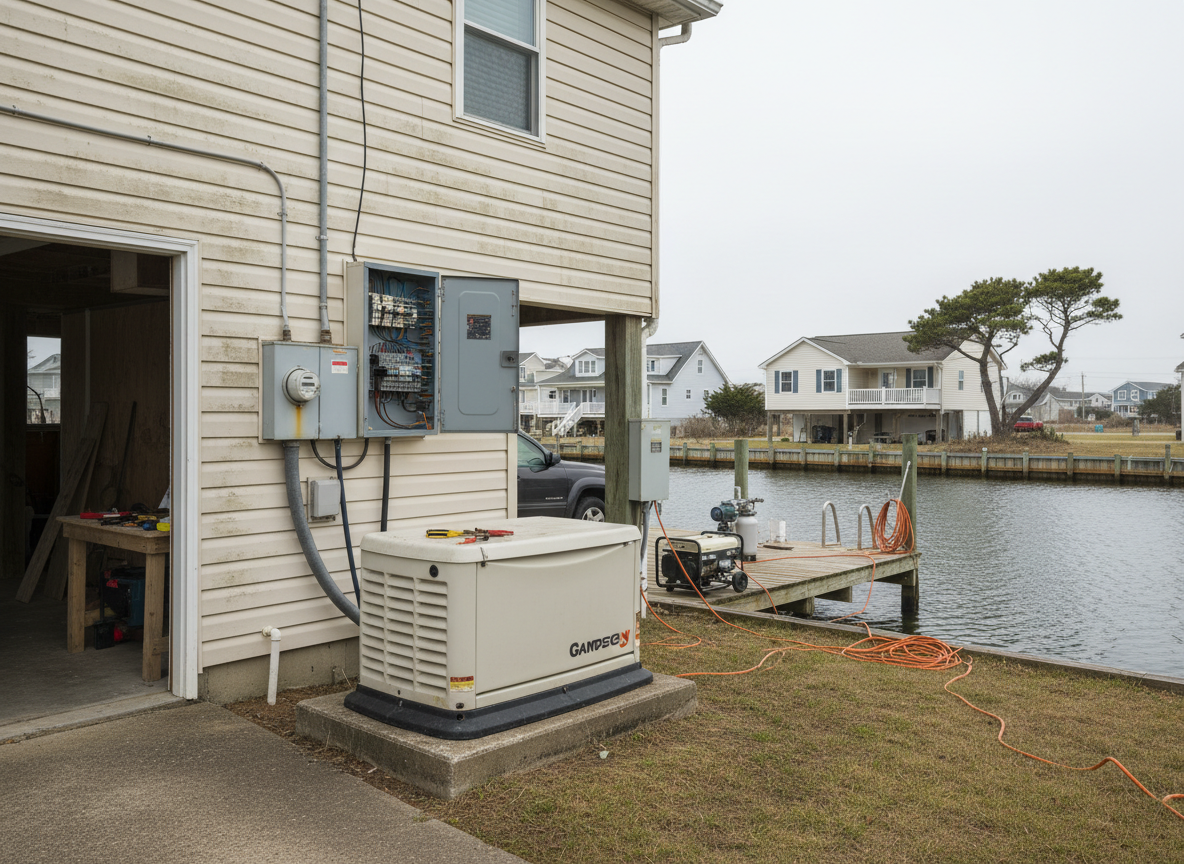
A portable generator covers a few circuits for a few hours and needs a person to start it, refuel it and shut it down. A standby generator starts on its own, runs on natural gas or propane, and carries a defined load for days. The deciding factors are outage length, fuel access and whether anyone is home.
What a Coastal Outage Actually Looks Like
Outage planning goes wrong when people size for the wrong event. There are two different failures here, and they need different equipment.
The first is the short outage: a summer thunderstorm drops a limb on a lateral, JCP&L reroutes or repairs, and power is back in two to eight hours. A portable generator handles that comfortably. The second is the storm outage: a nor'easter or a hurricane remnant takes down distribution across a wide section of Ocean County, crews work priority order starting with substations and main feeders, and residential laterals come last. That runs days, not hours, and it arrives with conditions that make a portable hard to use. Stations without power cannot pump gas. Roads flood. Nobody wants to be outside refueling at 3 a.m. in sideways rain.
The Sandy rebuild changed the local math. Many homes came back raised on pilings with service equipment relocated above base flood elevation, and once a meter base and panel have already been moved for flood reasons, adding an elevated generator pad and transfer switch is a smaller step than it looks. That is much of why standby installs cluster in Ortley Beach, Silverton, Shelter Cove and the lagoon neighborhoods.
The Mechanical Difference That Matters
The engine is the least interesting part of the comparison. The important differences are fuel, transfer and duty cycle.
A portable runs on gasoline, which you store, rotate and stabilize, and which goes stale. Typical run time on a tank is 8 to 12 hours at partial load, so a three day outage means multiple refuelings and hot restarts. A standby unit runs on natural gas from the street or propane from a tank, so the fuel supply is not something you carry. Natural gas removes refueling entirely as long as the gas system stays pressurized. Propane is finite but measured in days, and a larger tank buys more days.
Transfer is the piece homeowners underestimate. A standby generator pairs with an automatic transfer switch, which senses the loss of utility voltage, waits out a short delay, signals the generator to start, and mechanically transfers the load. It also blocks any path back onto the utility line, which is what keeps line crews safe. A portable generator needs either a manual transfer switch feeding selected circuits or an interlock kit on the panel, a metal slide that physically prevents the main breaker and the generator breaker from being on at the same time. Extension cords from the generator to individual appliances are the third option and the only one that needs no panel work, but it means no hardwired loads at all: no furnace, no well pump, no lights.
Duty cycle is the last piece. A standby unit is built for continuous running and exercises itself weekly. A portable engine is built for intermittent use, and running one flat out for 72 hours is how you find its limits.
Sizing, and Where People Get It Wrong
Sizing starts with a load calculation, not a wish list. The largest starting loads dominate the number, because motors draw several times their running current for a moment at startup. A well pump, a septic pump, a central air compressor and a refrigerator compressor all behave this way, and if two of them start at once on an undersized generator, voltage sags and the generator stalls or the breaker trips.
The realistic tiers look like this:
- Essential circuits only, roughly 5,000 to 7,500 watts: refrigerator, furnace or boiler controls, sump pump, well pump, a few lighting and receptacle circuits, internet. A portable unit with a manual transfer switch or interlock covers this.
- Essentials plus one air conditioning zone, roughly 10,000 to 14,000 watts. This is where standby units start making sense, because a portable running near capacity for days is not comfortable to live with.
- Whole house, 18,000 watts and up, which is a standby unit with an automatic transfer switch and often load management that sheds the AC when the range and the dryer are running.
The common misdiagnosis is a homeowner who says the generator is too small because lights dim when the well pump kicks. Often the unit is adequate and the problem is that everything was put on it at once with no load shedding, or the generator has never been serviced and is not producing rated output.
Salt Air, Placement and What Makes the Install Harder
Coastal placement drives most of the cost variance on a standby job. The generator has to sit at or above the flood elevation that applies to the property, which on a raised home can mean an elevated platform with its own structural detail. It has to hold manufacturer clearances from windows, doors, vents and the property line. The gas run has to be sized for the appliance load, which sometimes means the gas service or meter needs upsizing on a separate timeline.
Then there is salt air. On bayfront and barrier island property, corrosion attacks enclosures, hinges, fasteners and the service mast long before it attacks the engine. Coated aluminum enclosures hold up better than steel. Outdoor disconnects and the transfer switch need NEMA 3R enclosures with intact gaskets, and stainless hardware is worth the small premium. On a service inspection near the water, the first things an electrician checks are the meter base for rust bleed at the bottom, the mast and weatherhead, and the outdoor disconnect for green corrosion on the lugs.
Both paths need a permit and inspection under the New Jersey Uniform Construction Code. Transfer equipment is not minor work, and a generator connection installed without inspection is exactly the kind of thing that surfaces at a home sale or an insurance claim.
When It Becomes a Safety Issue
Portable generators kill people every storm season, and almost always in one of three ways. Carbon monoxide from running the unit in a garage, a crawlspace, under a deck or near an open window. Fires from refueling a hot engine. And backfeeding, where somebody energizes the house through a receptacle with a double male cord and pushes voltage back onto the utility line. That last one endangers line crews and neighbors and has no safe version.
The rules are short. Run a portable outdoors, well away from the house, downwind, never in an enclosed space, with a working carbon monoxide alarm inside. Let it cool before refueling. Feed the house only through a transfer switch or interlock installed under permit. If a standby unit fails to transfer, alarms, or smells of gas, shut it down at its disconnect and leave it. An electrician can tell you in one visit whether your panel accepts an interlock, usually the fastest path to a safe portable hookup.
Frequently Asked Questions
Can I use a portable generator with an interlock kit instead of a transfer switch? Yes, where a listed interlock kit exists for your panel brand and model. The interlock is a metal slide that makes it physically impossible to close the main breaker and the generator breaker at the same time, which prevents backfeed onto the utility. It is generally less expensive than a manual transfer switch and lets you power any circuit in the panel. It still requires a permit and inspection.
How long can a standby generator run continuously? On natural gas, as long as the gas supply holds, with maintenance pauses for oil at intervals the manufacturer specifies. On propane, the limit is tank capacity and load, commonly measured in days rather than hours. Manufacturers publish maintenance intervals for extended runs, and long outages are exactly when skipping an oil check causes a shutdown.
Will a generator power my central air conditioning? It depends on the compressor's starting current, not its running watts. Many essential circuit portable setups cannot start a central AC compressor at all. Standby units in the mid range often can, sometimes with a soft starter on the compressor or a load management module that sheds other large appliances while the AC starts. A load calculation answers this before you buy.
Related reading: how transfer switches and generator sizing are handled on a coastal install.