2026-08-31 · Nick Petrucci
Pool and Hot Tub Bonding Rules Every New Jersey Owner Should Understand
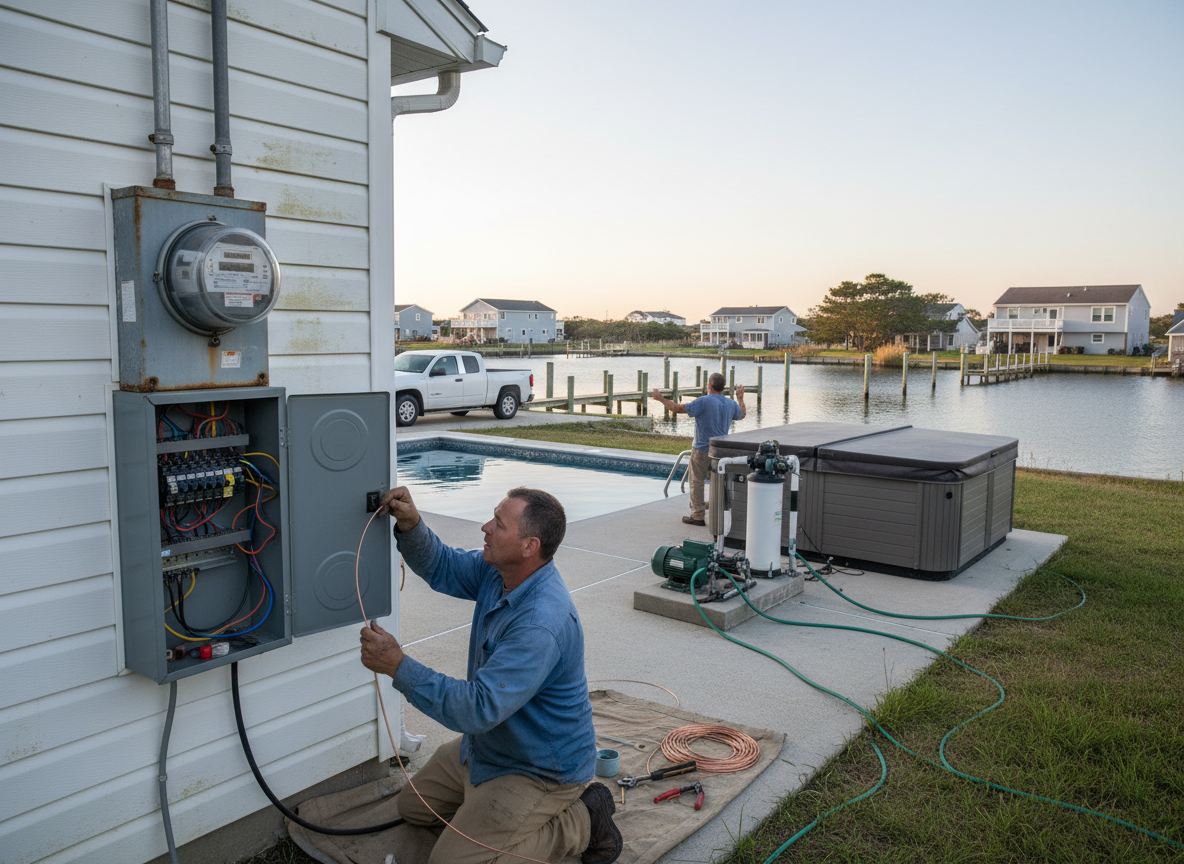
Every pool and hot tub needs an equipotential bonding system: a continuous copper conductor tying the water, the shell, the surrounding deck, the pump motor, ladders, rails and any nearby metal into one electrical unit. Bonding does not carry fault current to earth. It holds everything a swimmer can touch at the same voltage, so there is nothing to shock between.
The Mechanism: Same Potential Means No Current Through You
A shock needs a voltage difference between two points on your body. Stand in a pool with one hand on a wet ladder and both feet on the shell, and you have bridged three surfaces. If a nearby underground utility, a failing pump winding or a neighbor's service raises the potential of one of those surfaces even slightly relative to the others, current flows through you.
The bonding grid removes the difference. A solid copper conductor, typically 8 AWG, runs unbroken through the whole pool area and connects to:
- The structural steel of the shell, or the wall of a vinyl liner pool through bonding lugs
- A perimeter surface bond extending roughly 3 feet out from the pool edge, either mesh in the deck or a conductor loop
- The water itself, through a listed bonding fitting or a wetted metal surface of adequate area
- The pump motor bonding lug, the heater, and any metal within about 5 feet of the inside wall
Ground the pool without bonding it and you still have a shock path. Bond it without grounding and faults will not clear. The system needs both, doing separate jobs.
Grounding, GFCI and the Rules Around the Equipment Pad
Grounding and overcurrent protection handle the other half. The pump, heater and any pool light circuit run back to the panel on properly sized conductors with an equipment grounding conductor. GFCI protection is required on pool pump motor circuits, on outlets serving the pool equipment, and on any receptacle within the pool zone. Low voltage pool lighting still needs a transformer listed for the purpose. A 120 volt underwater luminaire needs GFCI protection on its branch circuit.
Distances matter and get missed constantly. Receptacles have to sit back a minimum distance from the inside wall of the pool, with a required GFCI protected receptacle within a defined band so nobody runs an extension cord across the deck. Overhead conductors have clearance requirements above the water surface, which becomes a live question on older Ocean County properties where the pool went in years after the service drop.
A hot tub adds its own set. Self contained spas need a disconnecting means within sight of the tub and set back from the water, so anyone working on it can kill power without walking to the panel. The feed is a 4 wire 240 volt circuit with GFCI protection, usually through a listed spa panel. The tub's own bonding lug ties into the same bonding system as the shell and the surrounding surface.
How Bonding Problems Actually Show Up
Almost nobody calls about bonding. They call about a tingle. A swimmer feels a buzz on the ladder, or on the coping when climbing out, or standing on wet concrete touching the rail. It is often intermittent, often worse when the pump runs, and it usually gets blamed on static or on the pool light.
What we check first, in order:
- Continuity between every accessible metal part and the bonding conductor. Ladder cups, rails, the diving board frame, the pump motor lug, the heater cabinet, the light niche. A single failed lug can leave one part of the grid isolated.
- The pump motor. Motors get replaced. The bonding lug on a replacement motor frequently does not get reconnected, because the pool company swapping it is not an electrical contractor and the lug is behind the mounting bracket.
- Voltage between metal parts and the water, and between the water and the deck, with the pump on and off, and with the panel main open and closed. That last step tells us whether the source is inside the property or coming in on the utility neutral.
- The panel and the pool feeder. Undersized conductors, a shared neutral, a missing equipment grounding conductor on an old run, or a GFCI breaker that has been swapped for a standard breaker at some point.
The most common misdiagnosis is treating a bonding failure as a leaking light fixture. Owners replace a perfectly good underwater luminaire and the tingle stays, because the actual fault is an isolated ladder cup or a pump lug that was never reconnected.
Why Toms River Pools Fail Faster
Two local conditions drive most of what we find. The first is salt air. Bonding lugs, motor frames and the buried conductor connections on bayfront and near bay properties corrode faster than inland installations. A copper conductor clamped to a rusted steel bracket loses continuity long before the bracket looks unusable.
The second is the age of the backyards. Pools installed at Holiday City, Silver Ridge Park and similar 1960s to 1980s neighborhoods predate the current bonding rules, and many were built before the perimeter surface bond was required at all. Those pools are legal as installed, but once the deck is replaced, the pump circuit is rewired or the shell is resurfaced, the work brings the bonding requirements current. Owners are often surprised that a deck job turns into an electrical permit and inspection through the Toms River Township Building Department.
The other complication is access. On a raised or rebuilt property the panel may now sit above base flood elevation on an exterior wall, and the original pool feeder was spliced during that move. We find junction boxes buried behind lattice, under decks and inside piling enclosures more often than anyone would like.
What To Do and When It Is Urgent
If anyone feels a tingle in or around the pool, shut off the pool circuits at the panel and keep people out of the water until it is tested. That is not overcaution. A shock strong enough to feel in a pool is strong enough to immobilize a smaller person, and immobilization in water is the actual danger.
Short of that, treat these as reasons to have the system checked: a pool pump replaced by anyone who did not reconnect the bonding lug, a GFCI that trips whenever the pump starts, a GFCI that will not reset, visible green corrosion on a bonding clamp, a hot tub without a visible disconnect near it, or a pool installed before the current perimeter bonding requirements. Bonding and GFCI work on pools is permitted and inspected work in New Jersey, and a documented inspection is also what an insurer or a buyer's home inspector will ask about.
If you want the bonding on an existing pool verified rather than assumed, that is a straightforward test we can run in an afternoon.
Frequently Asked Questions
Is bonding the same as grounding my pool? No. Grounding gives fault current a path back to the panel so a breaker trips. Bonding ties the pool shell, water, deck, ladders, rails and pump together so they all sit at the same voltage and there is no difference for current to flow across. A pool needs both. Having one does not substitute for the other, and most tingle complaints trace to bonding, not grounding.
Does an above ground pool need bonding too? Yes. Above ground pools with metal walls, metal ladders, a pump motor or nearby metal structures require bonding, and the pump circuit requires GFCI protection. The perimeter surface bonding requirement applies where there is a permanent walking surface around the pool. Storable inflatable pools are treated differently, but any pool with a permanently installed pump is in scope.
Why does my spa GFCI trip only on humid days? Moisture is finding a path to ground somewhere in the spa or its feed, and humid air lowers the resistance of that path enough to cross the 5 milliamp threshold. Common sources are a heater element beginning to fail, water in the spa panel or disconnect, or a damaged feeder. It is a real fault developing, not a device malfunction, and it should be traced rather than reset repeatedly.
Related reading: equipotential bonding on an existing pool.