2026-08-31 · Nick Petrucci
Dock Lighting, Boat Lifts and Shore Power: Bonding and GFCI Rules for Lagoon Properties
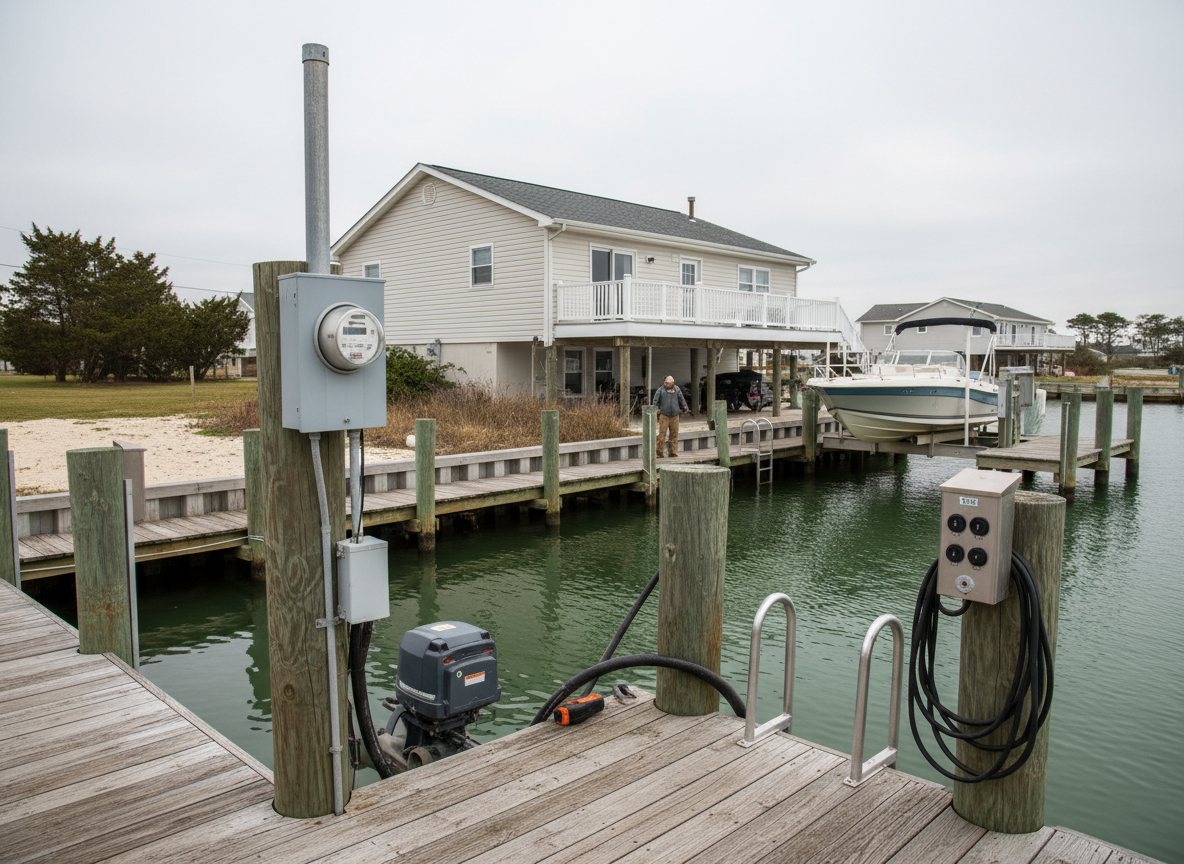
Every metal part on a dock has to be bonded together, every circuit feeding the dock has to have ground fault protection, and every enclosure has to survive salt air. Miss any one of those and current can leak into the water around the dock. On a narrow lagoon with almost no tidal flushing, that leakage does not disperse the way it does in open bay.
The Mechanism: Why Water Near a Dock Behaves Differently
Electricity does not care that it is underwater. If a hot conductor touches a metal lift frame, a piling bracket or a light fixture housing, that metal becomes energized. On dry land the equipment grounding conductor carries the fault back to the panel and trips the breaker. Underwater, the fault has a second option: it can push current through the water itself toward whatever the water touches, including a hull, a ladder or a person.
That current sets up a voltage gradient in the water. The voltage is highest right at the energized metal and drops off with distance. A swimmer bridging two points in that gradient has current flowing through their body from one hand to the other, or head to foot. It takes very little. Well below the current needed to trip a standard 20 amp breaker, a person loses muscle control, cannot swim, and goes under. That is electric shock drowning, and it is the reason dock wiring gets treated more seriously than a shed circuit.
Two things make this worse in a lagoon. First, brackish water conducts better than fresh water but worse than open ocean, and the middle of that range is where the gradient stays concentrated enough to be dangerous over a swimmable distance. Second, a dredged lagoon is a dead end. Water sits. Sediment builds. Neighboring docks, each with its own shore power pedestal and its own lift, all tie back to grounding systems in different houses. A fault at one dock can raise potential in water sitting between three or four properties.
Bonding Is Not Grounding
Homeowners use the words interchangeably. They are not the same job. Grounding connects the system to earth and gives fault current a path back to the source. Bonding ties all the metal parts together so they sit at the same voltage as each other. If everything is at the same potential, there is no gradient between them, and nothing to shock through.
On a dock that means the boat lift frame, the lift motor housing, the drive shaft bearings, metal pilings and piling caps, metal ladders, railings, cleats, the light pole bases and the shore power pedestal enclosure all get tied together with a continuous bonding conductor, then connected back to the service grounding system at the house. The conductor is typically solid copper, sized by the circuits involved, and every connection point uses a listed bonding lug rated for direct burial and wet contact rather than a sheet metal screw and a crimp.
The failure I see most often is not a missing bond. It is a bond that was installed correctly at the start and then rotted apart. A lug on a galvanized lift leg, ten years of salt spray, and the connection is a green crust that still looks attached. Continuity is gone. The lift still runs, the lights still work, and nothing indicates a problem until something faults.
Ground Fault Protection on Shore Power and Lift Circuits
Standard 15 and 20 amp 125 volt receptacles on a dock need GFCI protection at the usual 5 milliamp trip threshold, the same devices used in a bathroom. Shore power is different. Boats have inherent leakage current from their own onboard systems, and a 5 milliamp device would trip constantly and get bypassed by a frustrated owner, which is worse than no protection at all. The NEC handles this with equipment-level ground fault protection on the feeder or branch circuit supplying shore power, set to trip at a higher leakage level than a receptacle GFCI but far below what it takes to hurt someone in air. New Jersey enforces this through the Uniform Construction Code electrical subcode, and the Toms River Township Building Department inspects it on permitted dock work.
Boat lift motors need the same discipline. A lift is a 120 or 240 volt motor mounted on wet metal, cycled a few dozen times a season, sitting idle and damp the rest of the year. Ground fault protection on the lift circuit catches the winding insulation failure that would otherwise energize the frame silently.
What Salt Air and Brackish Water Do to the Hardware
Dock equipment fails from the outside in. What we find on Ocean County lagoons, in rough order of frequency:
- NEMA 3R enclosures with rusted-through bottoms, where the raintight rating was defeated by corrosion rather than by installation error
- GFCI receptacles that no longer reset because the internal contacts have corroded, or that reset but no longer trip on test
- Pedestal terminations where the strands under the lug have turned to powder
How an Electrician Actually Diagnoses a Dock
First stop is the house panel, not the dock. We identify which breakers feed the dock, confirm whether ground fault protection exists at all, and look at how the dock feeder leaves the building. On homes raised after Superstorm Sandy, the service equipment moved above base flood elevation, and dock circuits were frequently reconnected during the rebuild by whoever was on site. Reused conductors and improvised splices in a crawlspace or under a raised deck are common.
Then we test rather than assume. Continuity between every isolated piece of dock metal and the grounding system, one pair at a time. Insulation resistance on the lift motor. Function test on every GFCI with a real tester, not the button. A clamp meter on the shore power cord to read actual leakage with a boat connected. If readings look wrong, a voltage measurement in the water itself around the dock, with the shore power on and then off, tells us whether the source is this property or a neighbor.
Two misdiagnoses come up repeatedly. One is blaming the boat for leakage that is actually a wet dock receptacle. The other is treating a corroded bond as adequate because the lift operates normally. Operation proves the circuit conductors are intact. It proves nothing about the bonding path.
When This Becomes a Safety Issue
It is a safety issue the moment anyone swims near an energized dock, which means the threshold is much lower than most owners assume. Stop swimming and disconnect shore power if you feel any tingle in the water, if a lift or dock GFCI trips repeatedly, if a device will not reset, or if you can see corrosion at a bonding lug or enclosure. Repeated tripping is the system reporting a real fault, not a nuisance.
Dock and lift work needs a permit and an inspection in Toms River, and that is worth using rather than working around. If you want someone to test the bonding and ground fault protection on your dock before the season, we are happy to look at it.
Frequently Asked Questions
Can I get shocked in the water even if my dock wiring is fine? Yes. Voltage in the water can come from a neighboring dock, a boat with a wiring fault, or a shared lagoon grounding condition, not just from your own equipment. This is why we measure voltage in the water with your shore power both energized and shut off. If the reading stays up with your power off, the source is somewhere else and the neighboring property needs to be addressed.
Does a GFCI outlet on the dock cover the boat lift too? No, unless the lift circuit is actually downstream of that device, which it usually is not. Lift motors are typically fed by their own breaker and need ground fault protection on that circuit specifically. We trace the circuit rather than assuming, because dock branch circuits get rearranged over the years and panel labels on waterfront homes are often left over from before a rebuild.
How often should dock electrical equipment be inspected on a lagoon? Once a year, before the swimming season, is reasonable for lagoon properties. Salt air and standing humid conditions degrade enclosures, lugs and GFCI devices faster than inland installations. An annual check covers bonding continuity, GFCI function testing, enclosure integrity and leakage current at the shore power connection, which catches corrosion failures while they are still repairs rather than replacements.
Related reading: ground fault protection and bonding around water.