2026-08-31 · Nick Petrucci
Backfeeding a Generator Through a Dryer Outlet and Why Utility Crews Warn Against It
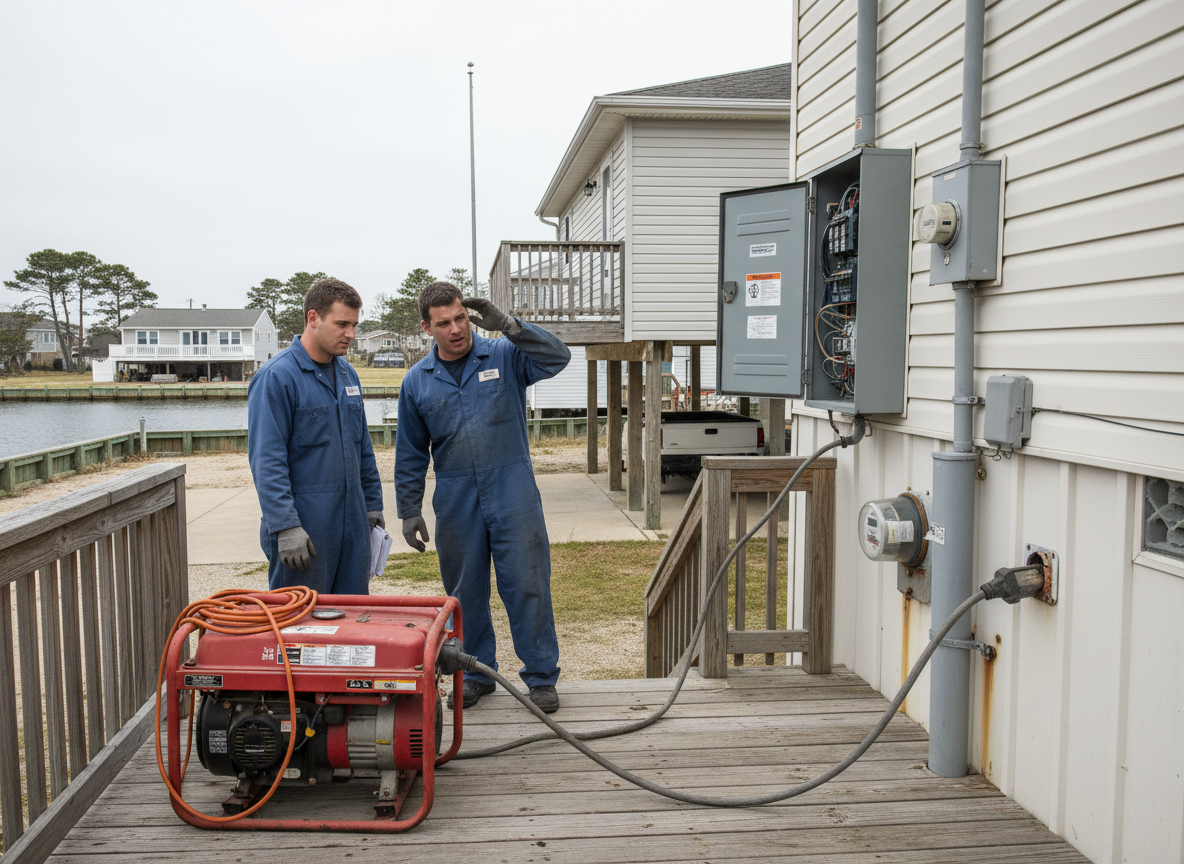
Backfeeding means plugging a generator into a dryer receptacle with a cord that has male plugs on both ends, energizing the house through the branch circuit. It endangers utility crews because current flows backward through the pole transformer, which steps 240 volts up to distribution voltage. It also leaves the cord unprotected.
What Is Physically Happening
A branch circuit is designed to carry power one direction: from the busbar in the panel, through a breaker, out to a load. The breaker protects the wire downstream of it. Backfeeding reverses that. Power enters the dryer receptacle, travels up the 10 gauge branch circuit conductors, through the 30 amp breaker, onto the busbar, and from there out to every other breaker in the panel.
Now follow it past the panel. If the main breaker is still closed, the busbar is still tied to the service entrance conductors, the meter base and the service drop. Generator output goes straight out to the pole. The utility transformer that normally steps distribution voltage down to 240 volts for your house works equally well in reverse. A 5,000 watt generator on the house side becomes several thousand volts on the primary side of that transformer, on a line a crew has grounded and is working on because their meters read it as dead.
That is the reason line crews and JCP&L talk about backfeed the way they do. It is not a theoretical exposure. Storm restoration in Ocean County puts crews on residential laterals in the dark, in wind, working sections they have tested and grounded, in neighborhoods where dozens of portable generators are running.
The Second Set of Problems, Inside Your Own House
The utility risk gets all the attention, but the household risks are real and they show up first.
- No overcurrent protection on the cord. In normal use, the breaker protects the wire. Backfed, the generator is the source and nothing in the path protects that cord. A pinched or damaged cord faults with only the generator's own breaker between it and a fire.
- Live exposed pins. A double male cord has energized prongs at the free end whenever the generator is running. There is no safe way to hold one.
- A 30 amp circuit feeding an unlimited panel. All the other breakers stay live, so anyone can switch on a load the generator cannot support. Overloaded generators stall, and stalling under load damages them and anything running at the time.
- Wrong voltage distribution. Many portables put out 120 volts on a single leg. Fed through a 240 volt dryer receptacle, one leg of the panel is energized and one is dead, so half the circuits work and half do not. Anything wired across both legs, such as a well pump or a range, sees 120 volts and behaves badly.
- Grounding and bonding are wrong. Older Toms River homes often have a three wire NEMA 10-30 dryer receptacle with no separate equipment ground. Backfeeding through it gives the generator no equipment grounding path back to the grounding electrode conductor, so metal enclosures throughout the house may not be at ground potential.
- Neutral bonding conflict. Most portable generators are neutral bonded at the frame. Tying that into a house system that is already bonded at the service creates parallel neutral paths, and current returns on grounding conductors and metal piping.
How an Electrician Spots It, and What Gets Missed
Backfeeding leaves evidence. On a service call after a storm, what gets checked first at the panel is the dryer breaker, which will often be warm or show discoloration at the lug from repeated hot connections under load. Then the dryer receptacle itself: arc pitting on the contacts, a scorched or melted face, a loose yoke where the plug was worked in and out in bad weather. In a garage or basement, a homemade cord coiled near the panel is the giveaway.
The common misdiagnosis runs the other way. A homeowner reports that half the house has no power after an outage and assumes a lost leg from the utility or a failing main breaker. Sometimes that is exactly what it is, a loose neutral or an open leg at the service. But if the house has been backfed on 120 volts through a 240 volt receptacle, the same symptom appears and the panel is fine. It gets sorted with a meter: readings leg to neutral and leg to leg at the main lugs, taken with the generator disconnected and utility restored.
The other thing that gets missed is damage that already happened. Motors and electronics that ran at the wrong voltage or on a stalling generator fail weeks later. Furnace control boards, well pump capacitors, refrigerator compressors and AC contactors are the usual casualties, and nobody connects it back to the outage.
What To Do Instead, and What It Costs You Not To
There are three legal ways to connect a portable generator, and all of them are cheaper than the consequences.
- Extension cords to individual appliances. No panel work, no permit, no risk to anyone else. The limitation is that nothing hardwired runs: no furnace, no sump pump, no well pump, no lighting.
- An interlock kit. A listed metal slide on the panel cover that makes it mechanically impossible to close the main breaker and the generator breaker at the same time. It requires a kit listed for your specific panel brand and model, an inlet box outside, and a permit. It is usually the least expensive hardwired option and lets you power any circuit in the panel one at a time.
- A manual transfer switch. A separate switch feeding a fixed set of circuits, with its own selector for each. More hardware and more labor than an interlock, but the circuit selection is fixed, which suits a house where several people may be operating it.
All three use a power inlet box, a weather rated recessed inlet outside the house, so the cord never has an exposed male end. On the water side of Toms River, that inlet and its enclosure should be NEMA 3R rated with intact gaskets, because salt air corrodes inlet pins and the corrosion shows up as heating at the connection.
When It Becomes an Emergency
Stop immediately and disconnect if you see or smell smoke near the panel or the dryer outlet, if the receptacle face is discolored or soft, if the cord or plug is hot, or if the generator is surging or stalling under load. Those are all late stage signs. Shut down the generator first, then unplug, then leave the main breaker off until an electrician has looked at the panel and the receptacle.
Anything backfed through a receptacle should be assumed to need the receptacle replaced and the breaker and busbar stab inspected, because repeated hot plugging damages the connection where it cannot be seen. If you have been getting through outages this way and want a permitted inlet and interlock installed instead, that is generally a half day of work on a standard panel.
Frequently Asked Questions
Is backfeeding through a dryer outlet illegal in New Jersey? Yes, in the sense that it violates the electrical subcode adopted under the New Jersey Uniform Construction Code, which requires transfer equipment that prevents interconnection with the utility supply. It also creates liability exposure if a line worker or neighbor is injured, and an insurer may deny a fire claim on wiring that was connected outside code. Permitted transfer equipment is the compliant path.
What if I turn the main breaker off first? Turning the main off removes the danger to line crews, but it does not fix the rest. The cord still has energized exposed pins, the cord still has no overcurrent protection, the grounding and neutral bonding are still wrong, and there is nothing preventing someone from closing the main while the generator is running. An interlock kit enforces that sequence mechanically instead of relying on memory.
How much does an interlock kit installation cost? It varies with the panel, the inlet location and the length of the run from the inlet to the panel, but it is typically the least expensive permitted option, well below a whole house transfer switch. Costs go up when the panel has no listed interlock available for its brand, when the panel is full, or when the panel itself is an obsolete type that should be replaced first.
Related reading: installing a power inlet and interlock so a portable generator connects safely.