2026-08-31 · Nick Petrucci
Aluminum Branch Wiring in 1960s and 1970s Ranch Homes and the Correct Repairs
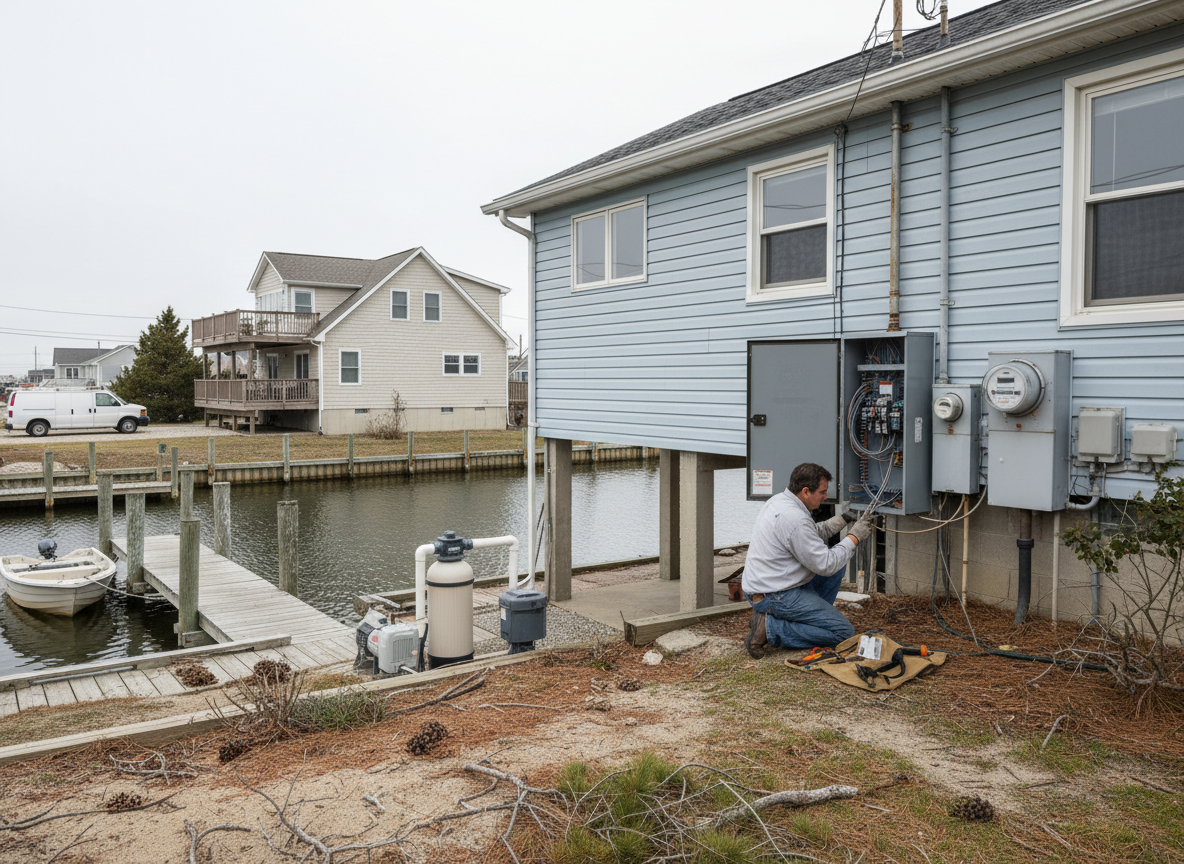
Homes wired between roughly 1965 and 1973 often have solid aluminum branch wiring on 15 and 20 amp circuits, and the hazard is at the connections rather than in the wire itself. Aluminum expands more than copper, creeps under pressure and oxidizes into a resistive layer, so terminations loosen and overheat. The accepted repairs are COPALUM crimps, AlumiConn connectors, or replacing the wiring.
Why Aluminum Terminations Fail
Four physical properties combine, and none of them is a defect in the metal so much as a mismatch with hardware designed for copper.
Thermal expansion. Aluminum expands and contracts more than copper for the same temperature change. A circuit that heats when a load runs and cools when it stops cycles the joint mechanically thousands of times a year.
Creep. Aluminum deforms slowly under sustained pressure. A screw torqued correctly at installation is looser a year later because the metal beneath it has flowed. Copper does this far less.
Oxidation. Aluminum forms an oxide film almost instantly on exposed metal, and that oxide is a poor conductor, unlike copper oxide which still conducts reasonably. Any gap that opens at a joint fills with an insulating layer.
Galvanic action. Where aluminum contacts steel screws or copper conductors with moisture present, corrosion accelerates at the interface. In coastal humidity this is not theoretical.
The result is a joint whose resistance climbs over time. Resistance under current produces heat, heat drives more expansion and more oxidation, and the process feeds itself. The dangerous part is where it happens: inside a device box, against the wood framing and insulation, with no circuit protection that can see it. A loose connection is not an overload, so the breaker never trips. That is why the risk is fire at outlets and switches rather than nuisance tripping.
Backstab connections make it worse. Many devices from that era were wired by pushing the conductor into a spring clip on the back of the receptacle rather than under the screw. Those clips were designed around copper, hold aluminum poorly, and are a routine find behind failed outlets in these houses.
How to Identify It
The wiring in question is single strand aluminum used for 15 and 20 amp branch circuits. It is not the same as the multi strand aluminum used for service entrance conductors and large feeders, which is normal, current practice and not a concern.
Where to look:
- Read the cable jacket. Exposed cable in an attic, basement or garage will be printed with AL, ALUM or ALUMINUM. Copper cable is printed CU or simply carries the wire gauge.
- Look at the conductor. Under the insulation aluminum is silver colored and dulls to grey. It is noticeably softer and nicks easily.
- Check the era. Slab on grade ranches in Holiday City and Silver Ridge Park, and other Ocean County construction from the late 1960s and early 1970s, are the primary population.
- Pull a receptacle. With the circuit off, a device pulled from the box shows the conductor color and how it was terminated directly.
- Look at the panel. Aluminum branch conductors landing on breaker lugs are visible when the dead front comes off.
Symptoms that point at aluminum terminations include warm or discolored receptacle and switch plates, a receptacle that has stopped working with no tripped breaker, flickering on one circuit, a faint smell of hot plastic, and arcing sounds behind a plate. Any of those on a house of this age deserves attention the same week.
The common misdiagnosis is treating a dead outlet as a bad device. An electrician replaces the receptacle, the circuit works, and the actual failed connection upstream, in a box further along the run or in a junction box in the attic, remains. Aluminum circuits often fail at the middle of a run, and open neutrals in these homes produce strange symptoms in other rooms entirely.
Another frequent error is trusting devices marked CU-AL. Standard CU-AL rated devices are not considered an adequate remedy for solid aluminum branch wiring. The CO/ALR rating is the one that applies to devices used with aluminum on 15 and 20 amp circuits, and even that is a partial measure covering only the device terminations, not splices in the box.
The Correct Repairs
There are three approaches that hold up.
- COPALUM crimp connectors. A copper pigtail is joined to the aluminum conductor with a metallurgical crimp made by a special tool, then insulated with a sleeve. This is considered a permanent repair. The limitation is practical: the tool is controlled and requires a trained installer, so availability varies.
- AlumiConn connectors. A three port lug body with set screws and an oxide inhibiting compound joins the aluminum conductor to a copper pigtail, torqued to a specified value. This is a recognized repair and is the more commonly available option in the field.
- Rewiring. Replacing the branch circuits with copper eliminates the problem outright. It is the most work and the most cost, and it is often the right call when the panel is also being replaced, when there is significant existing damage, or when a home is being renovated anyway.
Two methods are not acceptable substitutes. Ordinary twist on wire connectors are not a listed repair for aluminum to copper regardless of what compound is applied, and simply changing devices to CO/ALR while leaving splices alone addresses part of the circuit and leaves the rest.
The repair has to be done at every connection: every receptacle, every switch, every fixture, every junction box and the panel terminations. A partial job leaves the failure mechanism intact everywhere it was skipped, and the boxes people skip are the ones behind furniture, in closets and above ceilings.
What makes the work slow on site is box fill and conductor length. Adding pigtails and connector bodies into a shallow 1970s metal box that is already full is a real constraint, and boxes frequently need to be replaced with deeper ones or extended. Aluminum conductors nicked during original installation snap when they are moved, which means an unplanned splice. Plan on more time per opening than a copper job of the same size.
It becomes a safety issue immediately if anything is warm, discolored, arcing, smells hot, or has stopped working without a breaker tripping. Short of that, aluminum branch wiring is a scheduled remediation rather than an emergency, and pairing it with a panel replacement or a room renovation makes sense. If your home is from that era and you want to know what you actually have behind the plates, Electrician Toms River NJ can pull a sample of devices and tell you.
Frequently Asked Questions
Does aluminum wiring have to be removed entirely? No. A complete rewire is one option but not the only accepted one. COPALUM crimps or AlumiConn connectors, installed at every termination and splice, pigtail the aluminum to copper and are recognized remediation methods. Full rewiring makes the most sense when the wiring is already damaged, when the house is being renovated, or when other work has the walls open.
Are CU-AL rated outlets enough on their own? No. Standard CU-AL marked devices are not regarded as an adequate remedy for solid aluminum branch circuits. CO/ALR is the correct device rating for 15 and 20 amp aluminum branch wiring, and even CO/ALR devices only address the terminations on the device itself. Splices inside the box and connections in junction boxes still need a listed aluminum to copper method.
Will aluminum wiring stop me from getting homeowners insurance? It can. Some insurers decline coverage or require remediation before writing a policy, and others charge more or ask for documentation that approved connectors were installed. Because of that, homeowners in older Ocean County ranch communities often discover the issue during a policy renewal or a home sale rather than through a symptom in the house.
The scope of that work falls under aluminum branch circuit remediation and rewiring.